Result Complements — 结果补语
Overview
A result complement (结果补语, jiéguǒ bǔyǔ) is a word placed directly after a verb to show the result or outcome of the action. In English the result is often hidden inside the verb ("find" = look + success) or added loosely ("eat up"). Chinese is more systematic: the verb names the action, and a second word — the result complement — states how it turned out. Crucially, the verb alone does not imply a result: 我看书了 only means "I read / was reading," while 我看完书了 means "I finished the book." Each complement keeps a consistent core meaning across different verbs, so learning a dozen of them unlocks hundreds of natural combinations.
A result complement (结果补语) is a word placed right after a verb to show how the action turned out — 完 (finished), 到 (succeeded), 懂 (understood), 错 (wrongly), and more. The verb alone never implies the result.
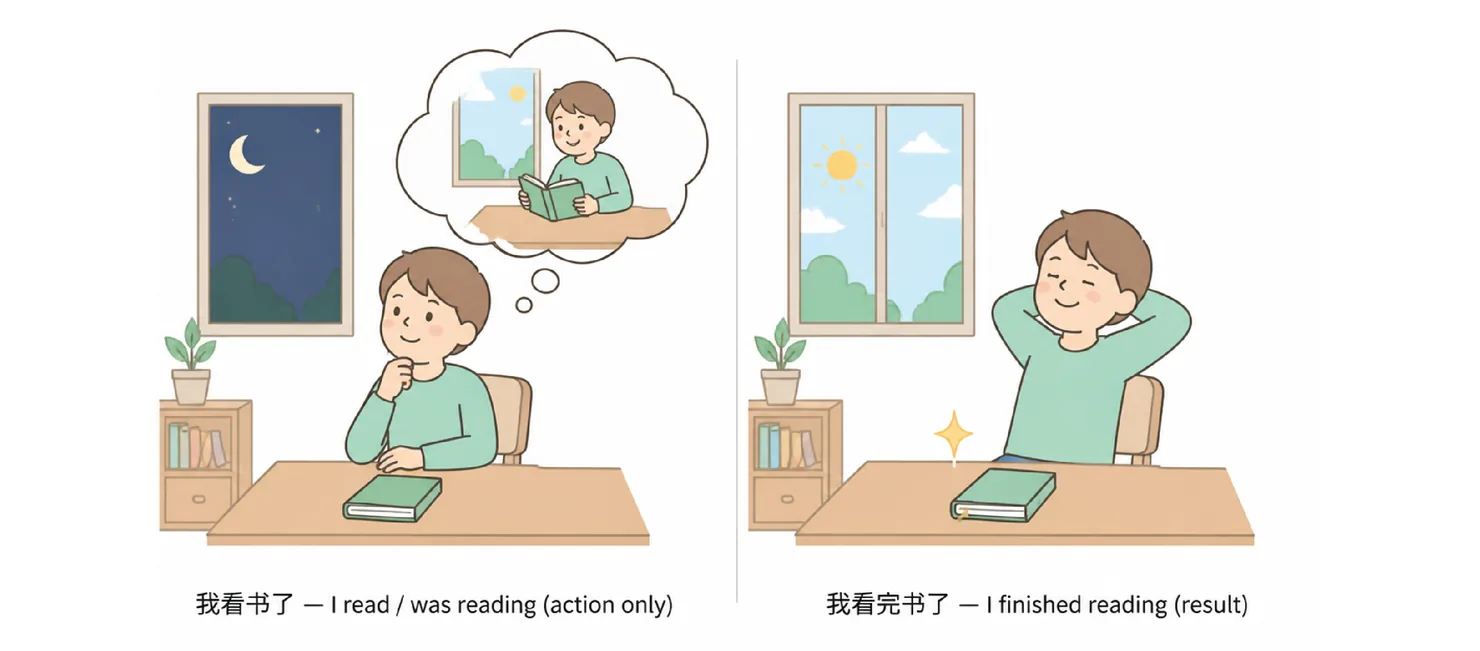 我看书了 (action only) vs. 我看完书了 (result: finished) — the complete only appears when you add 完.
Key rule: A result complement attaches directly to the verb (V + RC) with nothing in between. Negate the pair with 没 (not 不), and place 了 after the whole V+RC unit.
The Common Result Complements at a Glance
The table below is the map for this whole guide. Each row is one result complement, its core meaning, and a typical verb pairing — click any complement to jump to its detailed section further down, where you will also find a link to its full dedicated page.
Each row is one result complement with its core meaning and a typical pairing. Click one to jump to its section.
| Complement | Pinyin | Meaning after a verb | Typical pairing |
|---|---|---|---|
| 完 | wán | finished / used up | 吃完 chī wán — finish eating |
| 好 | hǎo | done properly / ready | 准备好 zhǔnbèi hǎo — get ready |
| 到 | dào | reached / succeeded | 找到 zhǎo dào — find |
| 懂 | dǒng | understood | 听懂 tīng dǒng — understand (by listening) |
| 错 | cuò | wrongly / by mistake | 写错 xiě cuò — write wrong |
| 见 | jiàn | perceived (senses) | 看见 kàn jiàn — see |
| 住 | zhù | held / secured / stopped | 记住 jì zhù — memorize |
| 开 | kāi | open / apart | 打开 dǎ kāi — open |
| 清楚 | qīngchǔ | clearly | 说清楚 shuō qīngchǔ — say clearly |
| 饱 | bǎo | full (from eating) | 吃饱 chī bǎo — eat one’s fill |
| 累 | lèi | tired (from doing) | 走累 zǒu lèi — get tired walking |
| 对 | duì | correctly | 猜对 cāi duì — guess right |
Sentence Structure
The core pattern is simple: the result complement sits immediately after the verb, and any object comes after the pair. Because the verb and complement act as a single unit, particles and objects arrange themselves around that unit, never inside it.
Verb + Result Complement act as one unit; the object and 了 come after the pair, never inside it.
Subject + Verb + ResultComplement + (Object) + (了)
Subject + 没 + Verb + ResultComplement + (Object) ← negation (result not achieved)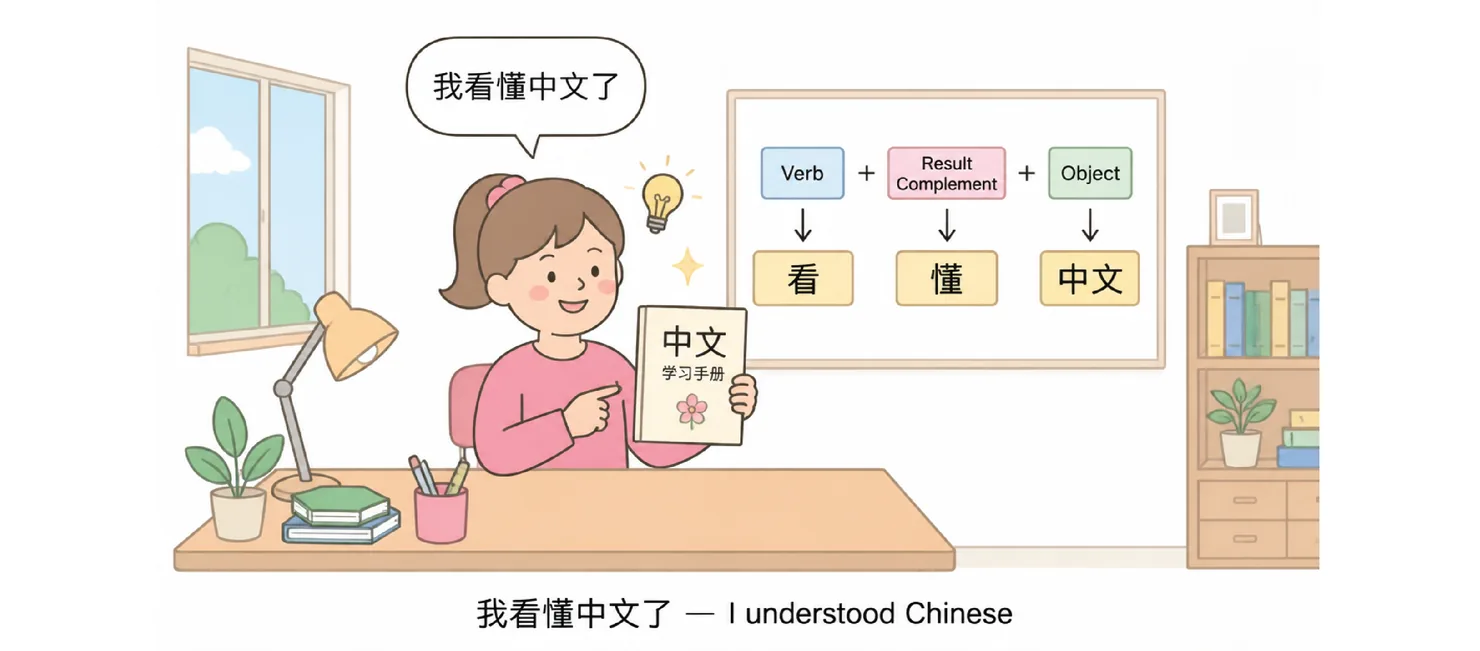 我看懂中文了 — “I understood Chinese.” The sentence is built as Verb (看) + Result Complement (懂) + Object (中文).
| Pattern | Chinese | Pinyin | English |
|---|---|---|---|
| S + V + RC | 我看懂了。 | Wǒ kàn dǒng le. | I understood (after reading). |
| S + V + RC + O | 我吃完饭了。 | Wǒ chī wán fàn le. | I finished eating. |
| S + V + RC + O + 了 | 他找到钥匙了。 | Tā zhǎo dào yàoshi le. | He found the keys. |
| S + 没 + V + RC + O | 我没听懂他的话。 | Wǒ méi tīng dǒng tā de huà. | I didn’t understand what he said. |
| V + RC + O + 吗? | 你写完作业了吗? | Nǐ xiě wán zuòyè le ma? | Have you finished your homework? |
Where 了 goes. Because the verb and complement are one unit, 了 attaches after the whole pair.
| Chinese | Pinyin | English | |
|---|---|---|---|
| ✅ Correct | 我吃完饭了。 | Wǒ chī wán fàn le. | I finished eating. |
| ❌ Incorrect | 我吃了完饭。 | Wǒ chī le wán fàn. | 了 cannot sit between the verb and the complement. |
The Twelve Common Result Complements
Each complement below has its own core meaning, its own set of compatible verbs, and its own nuances. Tap any section to expand a quick explanation with examples — and follow its link for the full dedicated guide with more verb pairings, deeper notes, and its own practice drills.
Tap any complement to expand it; each links out to a full dedicated page.
完
完 shows an action is fully completed — nothing remains to be done. It pairs with verbs of consuming, creating, or processing: 吃完 (finish eating), 做完 (finish doing), 写完 (finish writing), 看完 (finish reading/watching), 用完 (use up), 卖完 (sell out).
完 = finished, nothing left: 吃完, 做完, 看完, 用完, 卖完.
| Chinese | Pinyin | English |
|---|---|---|
| 我吃完饭了。 | Wǒ chī wán fàn le. | I finished eating. |
| 作业做完了吗? | Zuòyè zuò wán le ma? | Have you finished your homework? |
| 票都卖完了。 | Piào dōu mài wán le. | The tickets are all sold out. |
好
好 means an action is completed to a satisfactory, ready state — not merely "done well." 准备好了 means "fully ready," not "prepared nicely." Common pairings: 做好 (finish/prepare), 准备好 (get ready), 写好 (finish writing), 修好 (fix), 安排好 (arrange).
好 = done to a finished, ready state: 做好, 准备好, 写好, 修好.
| Chinese | Pinyin | English |
|---|---|---|
| 饭做好了。 | Fàn zuò hǎo le. | The meal is ready. |
| 你准备好了吗? | Nǐ zhǔnbèi hǎo le ma? | Are you ready? |
| 信写好了,可以寄了。 | Xìn xiě hǎo le, kěyǐ jì le. | The letter is done; it can be sent. |
到
到 marks that an action reached its goal — the effort succeeded. Common pairings: 找到 (find), 买到 (manage to buy), 看到 (see), 听到 (hear), 收到 (receive), 得到 (obtain).
到 = the action reached its goal / succeeded: 找到, 买到, 看到, 收到.
| Chinese | Pinyin | English |
|---|---|---|
| 你找到钥匙了吗? | Nǐ zhǎo dào yàoshi le ma? | Did you find the keys? |
| 我买到票了! | Wǒ mǎi dào piào le! | I managed to get tickets! |
| 他收到了很多礼物。 | Tā shōu dào le hěn duō lǐwù. | He received many gifts. |
懂
懂 shows that perceiving led to comprehension. It pairs with verbs of perception and study: 听懂 (understand by listening), 看懂 (understand by reading/watching), 读懂 (understand by reading), 学懂 (learn and grasp).
懂 = perceived and understood: 听懂, 看懂, 读懂.
| Chinese | Pinyin | English |
|---|---|---|
| 你听懂了吗? | Nǐ tīng dǒng le ma? | Did you understand (by listening)? |
| 我看懂了这篇文章。 | Wǒ kàn dǒng le zhè piān wénzhāng. | I understood this article (by reading it). |
| 他说得太快,我没听懂。 | Tā shuō de tài kuài, wǒ méi tīng dǒng. | He spoke too fast; I didn’t understand. |
错
错 shows the action was carried out wrongly. Common pairings: 写错 (write wrong), 说错 (say wrong), 拿错 (take the wrong one), 听错 (mishear), 看错 (misread/see wrong), 走错 (go the wrong way).
错 = did the action wrongly: 写错, 说错, 拿错, 走错.
| Chinese | Pinyin | English |
|---|---|---|
| 你写错字了。 | Nǐ xiě cuò zì le. | You wrote the character wrong. |
| 我拿错包了! | Wǒ ná cuò bāo le! | I took the wrong bag! |
| 他走错路了。 | Tā zǒu cuò lù le. | He went the wrong way. |
见
见 marks a successful sensory perception. It attaches only to verbs of the senses: 看见 (see), 听见 (hear), 闻见 (smell), 梦见 (dream of). 看见 and 听见 are extremely common fixed words.
见 = successfully perceived with a sense: 看见, 听见, 闻见.
| Chinese | Pinyin | English |
|---|---|---|
| 你看见他了吗? | Nǐ kàn jiàn tā le ma? | Did you see him? |
| 我听见有人在唱歌。 | Wǒ tīng jiàn yǒu rén zài chàng gē. | I hear someone singing. |
| 你闻见香味了吗? | Nǐ wén jiàn xiāngwèi le ma? | Do you smell the fragrance? |
住
住 shows the action makes something firm, fixed, or retained. Common pairings: 记住 (memorize, fix in memory), 抓住 (grab hold of), 停住 (come to a stop), 站住 (halt), 拦住 (block).
住 = held firmly / fixed in place: 记住, 抓住, 停住, 站住.
| Chinese | Pinyin | English |
|---|---|---|
| 你记住这个词了吗? | Nǐ jì zhù zhège cí le ma? | Did you memorize this word? |
| 请抓住扶手。 | Qǐng zhuā zhù fúshǒu. | Please hold onto the handrail. |
| 车停住了。 | Chē tíng zhù le. | The car came to a stop. |
开
开 shows the action results in something opening or separating. Common pairings: 打开 (open), 推开 (push open), 拉开 (pull open), 分开 (separate), 走开 (go away).
开 = opened or moved apart: 打开, 推开, 拉开, 分开.
| Chinese | Pinyin | English |
|---|---|---|
| 请把门打开。 | Qǐng bǎ mén dǎ kāi. | Please open the door. |
| 他把窗户推开了。 | Tā bǎ chuānghu tuī kāi le. | He pushed the window open. |
| 他们终于分开了。 | Tāmen zhōngyú fēn kāi le. | They finally separated. |
清楚
清楚 (a two-syllable complement) shows the action was done clearly — with a clear result for the senses or mind. Common pairings: 说清楚 (say clearly), 听清楚 (hear clearly), 看清楚 (see clearly), 想清楚 (think through), 写清楚 (write legibly).
清楚 = done clearly: 说清楚, 听清楚, 看清楚, 想清楚.
| Chinese | Pinyin | English |
|---|---|---|
| 请你说清楚。 | Qǐng nǐ shuō qīngchǔ. | Please say it clearly. |
| 我没听清楚。 | Wǒ méi tīng qīngchǔ. | I didn’t hear it clearly. |
| 你看清楚了吗? | Nǐ kàn qīngchǔ le ma? | Did you see it clearly? |
饱
饱 is a specialized complement meaning full from eating. It pairs mainly with 吃 and 喝: 吃饱 (eat one's fill), 喝饱 (drink one's fill).
饱 = full from eating: 吃饱, 喝饱.
| Chinese | Pinyin | English |
|---|---|---|
| 我吃饱了。 | Wǒ chī bǎo le. | I’m full. |
| 他没吃饱。 | Tā méi chī bǎo. | He isn’t full. |
累
累 shows an action left the doer tired. Common pairings: 走累 (tired from walking), 跑累 (tired from running), 看累 (tired from reading/watching), 站累 (tired from standing).
累 = tired as a result of doing something: 走累, 跑累, 看累.
| Chinese | Pinyin | English |
|---|---|---|
| 我走累了。 | Wǒ zǒu lèi le. | I’m tired from walking. |
| 他跑累了。 | Tā pǎo lèi le. | He’s tired from running. |
| 我看累了,想休息一下。 | Wǒ kàn lèi le, xiǎng xiūxi yíxià. | I’m tired from reading; I want to rest a bit. |
对
对 shows the action was done correctly — the opposite of 错. Common pairings: 猜对 (guess right), 说对 (say correctly), 写对 (write correctly), 答对 (answer correctly), 做对 (do correctly).
对 = did the action correctly (opposite of 错): 猜对, 说对, 写对, 做对.
| Chinese | Pinyin | English |
|---|---|---|
| 你猜对了! | Nǐ cāi duì le! | You guessed correctly! |
| 你把名字写对了。 | Nǐ bǎ míngzi xiě duì le. | You wrote the name correctly. |
| 这道题我做对了。 | Zhè dào tí wǒ zuò duì le. | I did this problem correctly. |
The Five Core Rules
Whichever complement you use, the same handful of rules govern how it behaves in a sentence. These are the errors learners make most often — and how to avoid them.
Five rules govern every result complement, whichever one you pick.
Rule 1 — The complement attaches directly to the verb. Nothing (not even 了) may come between them; V + RC is one unit.
| Chinese | Pinyin | English | |
|---|---|---|---|
| ✅ Correct | 我看完电影了。 | Wǒ kàn wán diànyǐng le. | I finished watching the movie. |
| ❌ Incorrect | 我看了完电影。 | Wǒ kàn le wán diànyǐng. | 了 cannot separate the verb and the complement. |
Rule 2 — Negate with 没, not 不, for completed actions. To say an action didn’t achieve its result, put 没 before the V+RC pair.
| Chinese | Pinyin | English | |
|---|---|---|---|
| ✅ Correct | 我没买到票。 | Wǒ méi mǎi dào piào. | I didn’t manage to buy tickets. |
| ❌ Incorrect | 我不买到票。 | Wǒ bù mǎi dào piào. | 不 is not used to negate a completed result. |
(不 does appear with complements — but only in the potential form 吃不完 “can’t finish,” a different structure covered below.)
Rule 3 — The verb alone does not imply a result. Without a complement, the sentence describes only the action, and the listener can’t tell whether it succeeded.
| Verb alone | Pinyin | With result | Pinyin | Difference |
|---|---|---|---|---|
| 我看书了。 | Wǒ kàn shū le. | 我看完书了。 | Wǒ kàn wán shū le. | reading vs. finished |
| 我找钱包。 | Wǒ zhǎo qiánbāo. | 我找到钱包了。 | Wǒ zhǎo dào qiánbāo le. | searching vs. found |
Rule 4 — 了 goes after the whole V+RC unit, whether or not an object follows: 我吃完了 (Wǒ chī wán le), 我吃完水果了 (Wǒ chī wán shuǐguǒ le, “I finished the fruit”).
Rule 5 — Many V+RC pairs are fixed vocabulary. Learn them as single chunks: 看见 (kànjiàn, see), 听见 (tīngjiàn, hear), 找到 (zhǎodào, find), 记住 (jìzhù, memorize), 打开 (dǎkāi, open), 听懂 (tīngdǒng, understand).
Verb Alone vs. Verb + Result Complement
Result complements matter because they change the meaning, not just add words. The same verb with and without its complement tells the listener two different things — action versus outcome. Native speakers always add the complement when they mean the result.
The same verb means something different with and without its complement — action vs. outcome.
| Verb alone | English | + Result | English |
|---|---|---|---|
| 我喝水了。 (Wǒ hē shuǐ le.) | I drank / was drinking water. | 我喝完水了。 (Wǒ hē wán shuǐ le.) | I finished the water. |
| 我写信了。 (Wǒ xiě xìn le.) | I wrote / was writing a letter. | 我写完信了。 (Wǒ xiě wán xìn le.) | I finished the letter. |
| 我找手机。 (Wǒ zhǎo shǒujī.) | I’m looking for my phone. | 我找到手机了。 (Wǒ zhǎo dào shǒujī le.) | I found my phone. |
| 我听新闻。 (Wǒ tīng xīnwén.) | I listen to the news. | 我听懂新闻了。 (Wǒ tīng dǒng xīnwén le.) | I understood the news. |
| 我写名字。 (Wǒ xiě míngzi.) | I write my name. | 我写错名字了。 (Wǒ xiě cuò míngzi le.) | I wrote my name wrong. |
| 你猜数字。 (Nǐ cāi shùzì.) | You guess the number. | 你猜对数字了! (Nǐ cāi duì shùzì le!) | You guessed the number right! |
The Potential Form (V得/不 + RC)
Closely related to result complements is the potential form, which inserts 得 ("can") or 不 ("cannot") between the verb and the complement to say whether the result is achievable. It is a distinct HSK 3 grammar point, but it grows directly out of the pairs on this page, so it is worth recognizing early.
Insert 得 / 不 between verb and complement to say the result can or cannot happen: 听得懂 (can understand) / 听不懂 (can't understand).
| Structure | Chinese | Pinyin | English |
|---|---|---|---|
| V + 得 + RC | 听得懂 | tīng de dǒng | can understand (by listening) |
| V + 不 + RC | 听不懂 | tīng bu dǒng | cannot understand |
| V + 得 + RC | 找得到 | zhǎo de dào | can find |
| V + 不 + RC | 找不到 | zhǎo bu dào | cannot find |
Don’t confuse it with plain negation. 没 states a fact (it didn’t happen); 不…RC states an ability (it can’t happen): 我没写完 (Wǒ méi xiě wán, “I didn’t finish”) vs. 我写不完 (Wǒ xiě bu wán, “I can’t finish”).
Result vs. Other Complement Types
Result complements are one of several complement families. The most useful contrasts: directional complements show movement (and often combine with result complements), degree complements show extent, and potential complements show possibility.
Result = outcome; [directional](/grammar/directional-complements/) = movement; degree = extent; potential = possibility.
| Feature | Result complement | Directional complement | Degree complement |
|---|---|---|---|
| Shows | outcome | movement direction | degree / extent |
| Examples | 吃完, 看懂, 找到 | 上来, 进去, 出来 | 好极了, 累死了 |
| Pinyin | chī wán, kàn dǒng, zhǎo dào | shàng lái, jìn qù, chū lái | hǎo jíle, lèi sǐle |
| English | finish, understand, find | come up, go in, come out | extremely good, exhausted |
One verb can even take both a result and a directional sense: 我看懂了 (Wǒ kàn dǒng le, “I understood”) — result; 我把书拿上来了 (Wǒ bǎ shū ná shàng lái le, “I brought the book up”) — directional. See directional complements for the movement family, often used inside the 把 sentence.
Quick Reference Chart
Everything on this page, condensed. Use it as a cheat sheet while you practice.
A condensed cheat sheet of the complements and core patterns.
| Complement | Pinyin | Meaning | Typical verbs |
|---|---|---|---|
| 完 | wán | finish / complete | 吃, 看, 写, 做, 喝, 用 |
| 好 | hǎo | done properly / ready | 做, 准备, 写, 修, 安排 |
| 到 | dào | reach / succeed | 找, 买, 看, 听, 收, 得 |
| 懂 | dǒng | understand | 听, 看, 学, 读 |
| 错 | cuò | wrongly | 写, 说, 拿, 听, 看, 走 |
| 见 | jiàn | perceive (senses) | 看, 听, 闻, 梦 |
| 住 | zhù | hold / secure / stop | 记, 抓, 停, 站, 拦 |
| 开 | kāi | open / apart | 打, 推, 拉, 分, 走 |
| 清楚 | qīngchǔ | clearly | 说, 听, 看, 想, 写 |
| 饱 | bǎo | full (eating) | 吃, 喝 |
| 累 | lèi | tired (from doing) | 走, 跑, 看, 站 |
| 对 | duì | correctly | 猜, 说, 写, 答, 做 |
| Pattern | Chinese | Pinyin | English |
|---|---|---|---|
| V + RC | 我看懂了。 | Wǒ kàn dǒng le. | I understood. |
| V + RC + O | 我吃完水果了。 | Wǒ chī wán shuǐguǒ le. | I finished the fruit. |
| 没 + V + RC | 我没找到钥匙。 | Wǒ méi zhǎo dào yàoshi. | I didn’t find the keys. |
| V + 得 + RC | 我吃得完。 | Wǒ chī de wán. | I can finish eating. |
| V + 不 + RC | 我吃不完。 | Wǒ chī bu wán. | I can’t finish eating. |
Drills
Choose the correct result complement for each blank. Use the English hint under each sentence — it tells you which outcome is meant (finished, succeeded, understood, perceived, and so on). Click 🔀 New Questions for a fresh set of 10 from the full 120-sentence pool covering all twelve complements.
Notes
- Result complements are tightly bonded to the verb — no pause or particle sits between them.
- Many V+RC pairs are learned as fixed vocabulary: 看见, 听见, 找到, 记住, 打开.
- 好 means “completed to a satisfactory, ready state,” not merely “done nicely” — 准备好了 = “fully ready.”
- The potential form (V得RC / V不RC, e.g. 做得完 “can finish” vs 做不完 “can’t finish”) is a distinct HSK 3 topic that builds on these pairs.
Sources
HSK Standard Course 2 — L9 (结果补语, result complements introduced) HSK Standard Course 3 — L1 (结果补语 “好”), L6 (V得/不 + RC, potential form)