开 as a Result Complement — Open / Apart / Away
Overview
开 (kāi) is a result complement meaning something ends up open, apart, or moved away. When you attach 开 to a verb, you are saying the action created space or set something in motion away from a point: a closed thing opens, two things separate, or someone clears out of the way. 打开 is "open," 推开 is "push open / push away," 分开 is "separate." The unifying idea is creating separation or an opening — the exact opposite of 住, which fixes things in place.
开 (kāi) says something ends up open or apart: 打开 (open), 推开 (push open), 分开 (separate), 走开 (go away).
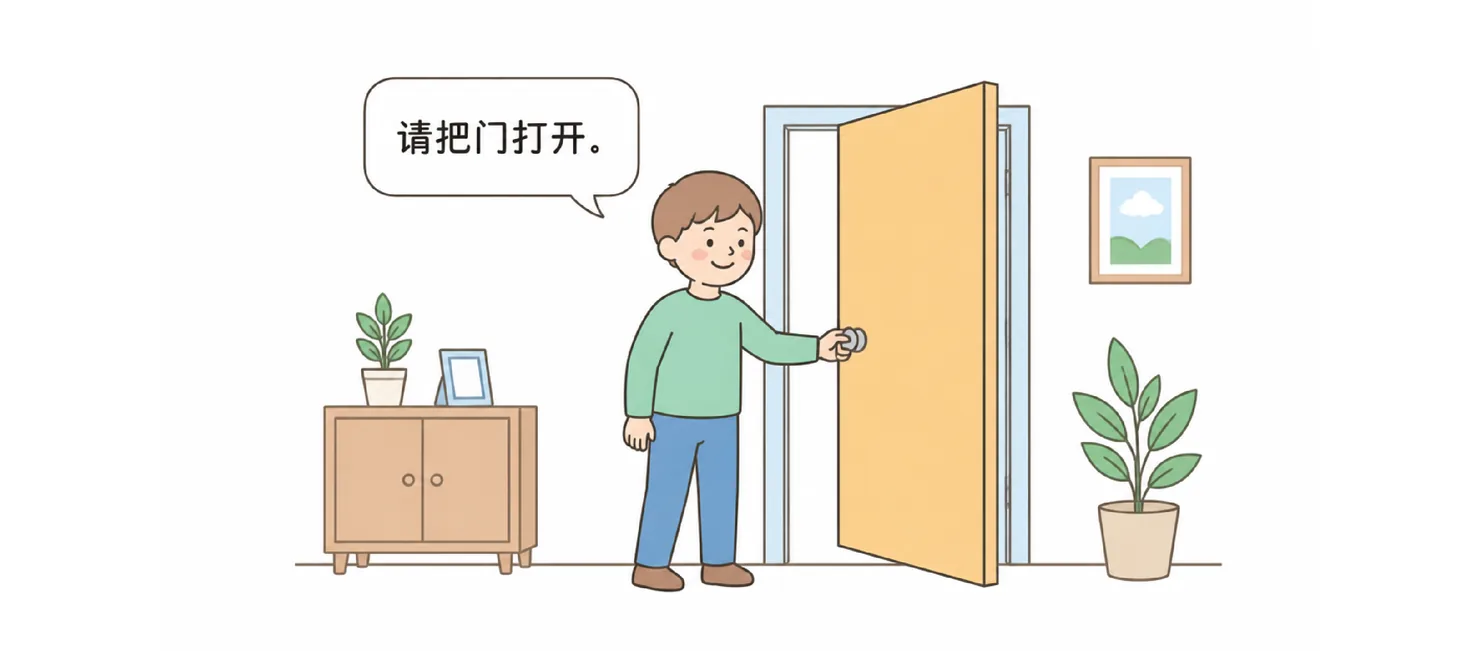 请把门打开 — “Please open the door.”
Key rule: 开 attaches directly to the verb, and the verb tells you how the opening happened — by pushing (推开), pulling (拉开), or striking/handling (打开).
What 开 Adds to the Verb
| Without 开 | Pinyin | With 开 | Pinyin | Difference |
|---|---|---|---|---|
| 我推了门。 | Wǒ tuī le mén. | 我推开了门。 | Wǒ tuī kāi le mén. | pushed vs. pushed it open |
| 他们分了。 | Tāmen fēn le. | 他们分开了。 | Tāmen fēn kāi le. | divided vs. became separated |
The Three Shades of 开
| Shade | What it means | Example |
|---|---|---|
| Opening | making a closed thing open | 打开 dǎ kāi — open; 张开 zhāng kāi — open (mouth, eyes, arms) |
| Moving apart / away | pushing, pulling or moving things apart | 推开 tuī kāi — push open; 分开 fēn kāi — separate; 走开 zǒu kāi — go away |
| Starting | setting an activity in motion | 开始 kāi shǐ — start / begin |
Which Verbs Pair with 开
| Verb + 开 | Pinyin | English | Verb + 开 | Pinyin | English |
|---|---|---|---|---|---|
| 打开 | dǎ kāi | open (door, box, book) | 躲开 | duǒ kāi | dodge / avoid |
| 推开 | tuī kāi | push open / push away | 让开 | ràng kāi | move aside |
| 拉开 | lā kāi | pull open / pull apart | 张开 | zhāng kāi | open (mouth, eyes, arms) |
| 分开 | fēn kāi | separate / divide | 走开 | zǒu kāi | go away / leave |
Note: 开始 (kāi shǐ, “to start”) historically uses 开 in this way, but it has become so common that it now works as a standalone verb in its own right.
Core Examples
| Chinese | Pinyin | English | Context |
|---|---|---|---|
| 请把门打开。 | Qǐng bǎ mén dǎ kāi. | Please open the door. | opening |
| 他把窗户推开了。 | Tā bǎ chuānghu tuī kāi le. | He pushed the window open. | pushing open |
| 他们终于分开了。 | Tāmen zhōngyú fēn kāi le. | They finally separated. | separation |
| 你先走开,我打个电话。 | Nǐ xiān zǒu kāi, wǒ dǎ ge diànhuà. | Step away a moment — I need to make a call. | moving away |
| 电影已经开始了。 | Diànyǐng yǐjīng kāi shǐ le. | The movie has already started. | beginning |
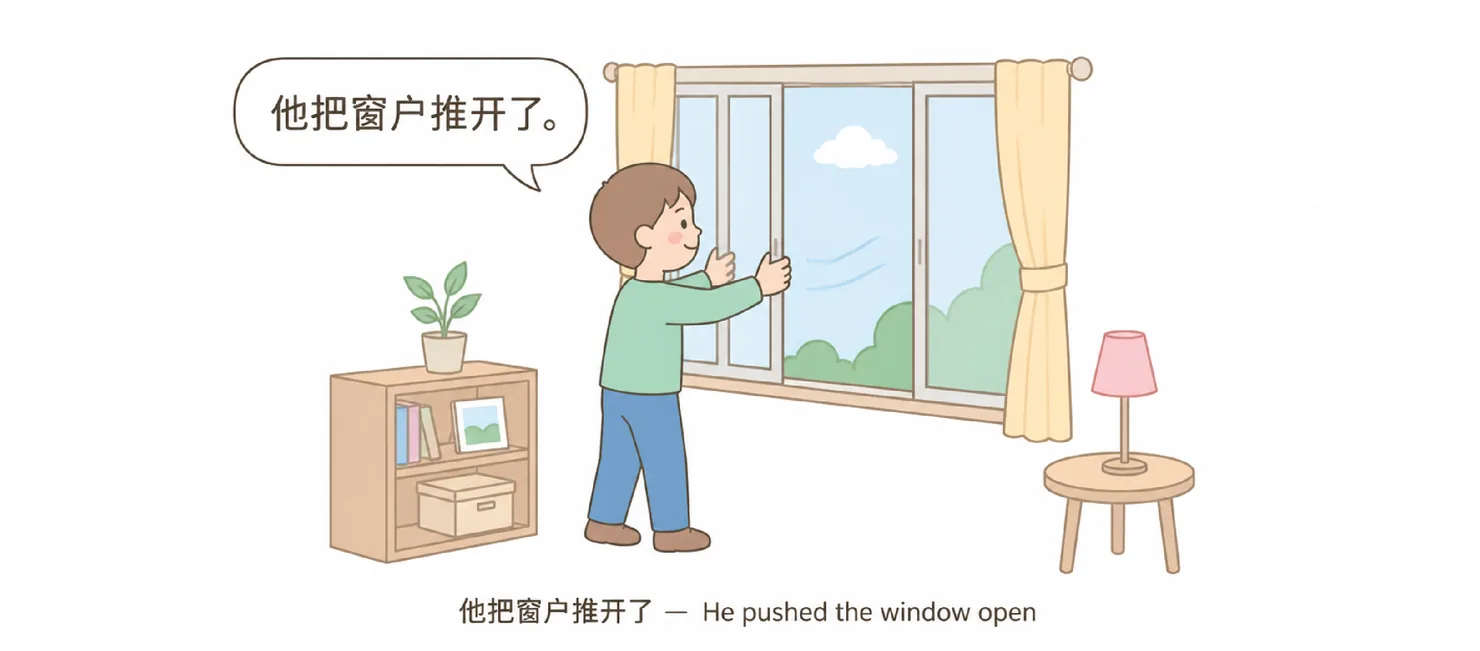 他把窗户推开了 — “He pushed the window open.”
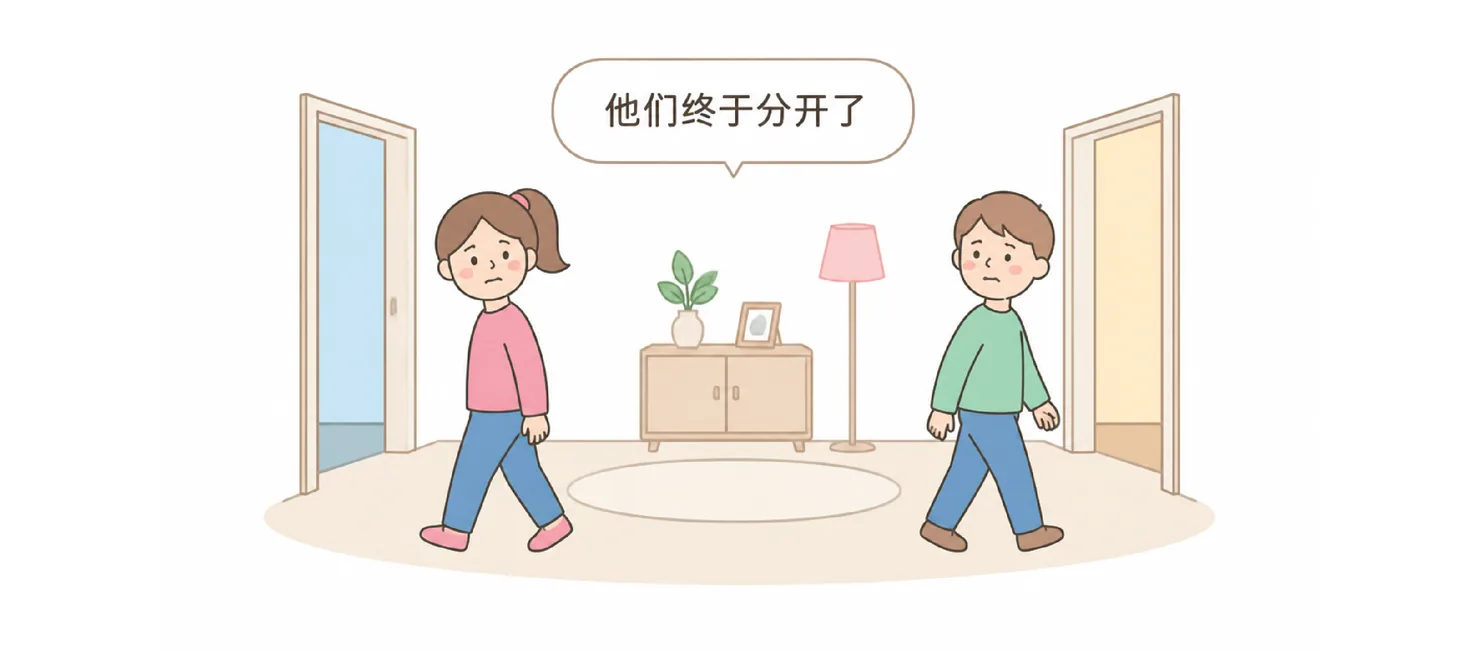 他们终于分开了 — “They finally separated.”
Nuance 1 — 开 Loves the 把 Sentence
Because 开 describes what happens to an object, it appears constantly in the 把 sentence, which foregrounds the object being acted on. In fact, a bare verb cannot end a 把 sentence — it needs a complement like 开 to state the outcome.
开 is very common in 把 sentences, which need a complement to state what happened to the object.
| Chinese | Pinyin | English |
|---|---|---|
| 请把门打开。 | Qǐng bǎ mén dǎ kāi. | Please open the door. |
| 他把窗户推开了。 | Tā bǎ chuānghu tuī kāi le. | He pushed the window open. |
| 请把书打开。 | Qǐng bǎ shū dǎ kāi. | Please open your book. |
Nuance 2 — 开 vs. 住: Opposite Outcomes
开 and 住 sit at opposite ends of the same idea. 开 creates separation or an opening; 住 fixes something in place. Comparing them makes both easier to remember.
开 opens or separates; 住 holds fixed. Direct opposites.
| Complement | Outcome | Chinese | Pinyin | English |
|---|---|---|---|---|
| 开 | opened / apart | 他推开了门。 | Tā tuī kāi le mén. | He pushed the door open. |
| 住 | held / stopped | 他拦住了我。 | Tā lán zhù le wǒ. | He blocked my way. |
Nuance 3 — Nothing Comes Between the Verb and 开
| Chinese | Pinyin | English | |
|---|---|---|---|
| ✅ Correct | 他推开了门。 | Tā tuī kāi le mén. | He pushed the door open. |
| ❌ Incorrect | 他推了开门。 | Tā tuī le kāi mén. | 了 cannot separate 推 and 开. |
Negation — Use 没, Not 不
| Chinese | Pinyin | English | |
|---|---|---|---|
| ✅ Correct | 我没打开那个盒子。 | Wǒ méi dǎ kāi nàge hézi. | I didn’t open that box. |
| ❌ Incorrect | 我不打开那个盒子。 | Wǒ bù dǎ kāi nàge hézi. | 没 is for completed actions, not 不. |
The one place 不 appears: the potential form — 打不开 (dǎ bu kāi, cannot get it open), 推不开 (tuī bu kāi, cannot push it open). Positive: 打得开 (dǎ de kāi, can get it open).
Quick Reference
| Point | Summary |
|---|---|
| Meaning | 开 = opened / apart / away |
| Attachment | directly after the verb — nothing in between |
| Object position | after the V+开 pair, or fronted with 把 |
| Negation | 没 for completed actions; 不 only in the potential form |
| 开 vs 住 | 开 = separate or open · 住 = hold fixed |
| Common verbs | 打, 推, 拉, 分, 走, 躲, 让, 张 |
Drills
Fill in the correct result complement. Choose from 开 / 住 / 完 / 到. Each question’s English meaning is the hint.
- 请把门打___。(Please open the door.)
- 他把窗户推___了。(He pushed the window open.)
- 他们终于分___了。(They finally separated.)
- 你先走___,我打个电话。(Step away a moment.)
- 请把书打___。(Please open your book.)
- 请把嘴张___。(Please open your mouth.)
- 车来了,快让___!(A car’s coming — move aside!)
- 请抓___扶手。(Please hold onto the handrail.)
- 车停___了。(The car came to a stop.)
- 你记___这个词了吗?(Did you memorize this word?)
- 我吃___饭了。(I finished eating.)
- 你找___钥匙了吗?(Did you find the keys?)
Answer Key: 1. 开 2. 开 3. 开 4. 开 5. 开 6. 开 7. 开 8. 住 9. 住 10. 住 11. 完 12. 到
Notes
- Common V+开 chunks: 打开, 推开, 拉开, 分开, 走开, 让开, 张开.
- 走开!and 让开!are blunt commands (“go away,” “move”) — useful to recognise, but sharp in tone.
- 开 pairs naturally with the 把 sentence, which requires a complement after the verb.
- For the opposite idea of fixing in place, see 住; for the whole family see result complements.
Sources
HSK Standard Course 3 — 结果补语 (开) HSK Standard Course 2 — L9 (结果补语, result complements introduced) HSK Standard Course 3 — L6 (V得/不 + RC, potential form)