对 as a Result Complement — Correctly
Overview
对 (duì) is a result complement telling the listener that an action produced a correct result — the guess was right, the answer was accurate, the character was written properly. 猜对 is "guess correctly," 答对 is "answer correctly," 写对 is "write correctly." 对 is the exact positive counterpart of 错 ("incorrectly"), and the two are best learned together: almost every verb that takes one also takes the other, which lets you describe any attempt as right or wrong with a single character swap.
对 (duì) says the action came out correctly: 猜对 (guessed right), 答对 (answered right), 写对 (wrote right). The opposite of 错.
 你猜对了!— “You guessed correctly!”
Key rule: 对 attaches directly to the verb. Swap it with 错 to flip the meaning from right to wrong.
What 对 Adds to the Verb
| Without 对 | Pinyin | With 对 | Pinyin | Difference |
|---|---|---|---|---|
| 我猜了答案。 | Wǒ cāi le dá’àn. | 我猜对了答案。 | Wǒ cāi duì le dá’àn. | guessed vs. guessed right |
| 他写了名字。 | Tā xiě le míngzi. | 他写对了名字。 | Tā xiě duì le míngzi. | wrote it vs. wrote it correctly |
Which Verbs Pair with 对
对 attaches to verbs whose outcome can be judged right or wrong — guessing, answering, writing, reading, performing a task.
对 pairs with verbs that have a right-or-wrong outcome.
| Verb + 对 | Pinyin | English | Verb + 对 | Pinyin | English |
|---|---|---|---|---|---|
| 猜对 | cāi duì | guess correctly | 答对 | dá duì | answer correctly |
| 说对 | shuō duì | say correctly | 做对 | zuò duì | do correctly |
| 写对 | xiě duì | write correctly | 读对 | dú duì | read correctly |
Compatibility: 对 needs an action that can be right or wrong. States are blocked — ❌ 喜欢对 (xǐhuān duì), ❌ 知道对 (zhīdào duì).
Core Examples
| Chinese | Pinyin | English | Context |
|---|---|---|---|
| 你猜对了! | Nǐ cāi duì le! | You guessed correctly! | after a right guess |
| 这道题我做对了。 | Zhè dào tí wǒ zuò duì le. | I did this problem correctly. | right answer |
| 你把他的名字写对了吗? | Nǐ bǎ tā de míngzi xiě duì le ma? | Did you write his name correctly? | correct writing |
| 老师的问题我都答对了。 | Lǎoshī de wèntí wǒ dōu dá duì le. | I answered all the teacher’s questions correctly. | test or class |
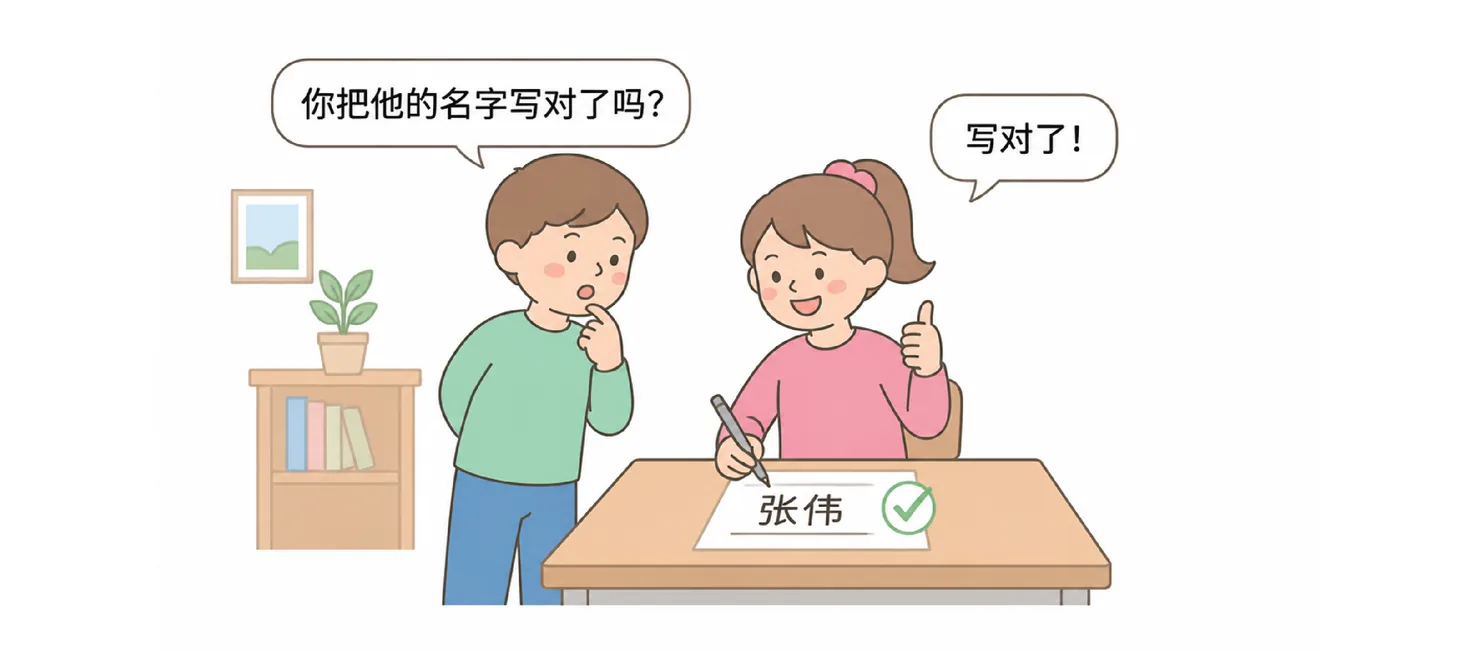 你把他的名字写对了吗?— 写对了!“Did you write his name correctly?” — “Wrote it correctly!”
 这道题我做对了 — “I did this problem correctly.”
Nuance 1 — 对 and 错 Are a Matched Pair
This is the most efficient thing to learn about 对. Because it is the mirror image of 错, every verb you know with one immediately gives you the other. Learning them side by side effectively doubles your vocabulary for describing outcomes.
对 = correctly, 错 = wrongly. The same verbs take both.
| Verb | With 对 (right) | Pinyin | With 错 (wrong) | Pinyin |
|---|---|---|---|---|
| 猜 | 猜对 — guess right | cāi duì | 猜错 — guess wrong | cāi cuò |
| 说 | 说对 — say correctly | shuō duì | 说错 — misspeak | shuō cuò |
| 写 | 写对 — write correctly | xiě duì | 写错 — write wrong | xiě cuò |
| 做 | 做对 — do correctly | zuò duì | 做错 — make a mistake | zuò cuò |
| Chinese | Pinyin | English |
|---|---|---|
| 我猜对了。 | Wǒ cāi duì le. | I guessed right. |
| 我猜错了。 | Wǒ cāi cuò le. | I guessed wrong. |
Nuance 2 — 对 as Complement vs. 对 as Adjective
对 is also an ordinary adjective meaning "right/correct," and a preposition meaning "toward." As a result complement it must follow a verb and report how that action turned out.
V+对 reports how an action turned out; standalone 对 just means "correct."
| 对 as… | Chinese | Pinyin | English |
|---|---|---|---|
| result complement | 你写对了。 | Nǐ xiě duì le. | You wrote it correctly. |
| adjective | 你的答案对。 | Nǐ de dá’àn duì. | Your answer is correct. |
Nuance 3 — Nothing Comes Between the Verb and 对
| Chinese | Pinyin | English | |
|---|---|---|---|
| ✅ Correct | 我做对了这道题。 | Wǒ zuò duì le zhè dào tí. | I did this problem correctly. |
| ❌ Incorrect | 我做了对这道题。 | Wǒ zuò le duì zhè dào tí. | 了 cannot separate 做 and 对. |
Negation — Use 没, Not 不
To say something was not done correctly, put 没 before the V+对 pair — though in practice Chinese usually prefers the positive statement with 错, which is more direct.
Negate with 没 — but saying it with 错 is usually more natural.
| Chinese | Pinyin | English | |
|---|---|---|---|
| ✅ Correct | 我没做对这道题。 | Wǒ méi zuò duì zhè dào tí. | I didn’t do this problem correctly. |
| ❌ Incorrect | 我不做对这道题。 | Wǒ bù zuò duì zhè dào tí. | 没 is for completed actions, not 不. |
More natural: 我做错了 (Wǒ zuò cuò le, “I did it wrong”).
Quick Reference
| Point | Summary |
|---|---|
| Meaning | 对 = the action produced a correct result |
| Attachment | directly after the verb — nothing in between |
| Object position | after the V+对 pair, or fronted with 把 |
| Negation | 没 for completed actions; usually better to use 错 |
| 对 vs 错 | 对 = correctly · 错 = wrongly (same verbs take both) |
| Common verbs | 猜, 说, 写, 答, 做, 读 |
Drills
Fill in the correct result complement. Choose from 对 / 错 / 完 / 到. Each question’s English meaning is the hint.
- 你猜___了!答案就是那个。(You guessed correctly!)
- 这道题我做___了。(I did this problem correctly.)
- 你把他的名字写___了吗?(Did you write his name correctly?)
- 老师的问题我都答___了。(I answered all the questions correctly.)
- 这个字你读___了。(You read this character correctly.)
- 你说___了,就是这个意思。(You said it correctly.)
- 对不起,我说___你的名字了。(Sorry, I said your name wrong.)
- 你写___字了,老师让你重写。(You wrote the character wrong.)
- 我拿___包了!(I took the wrong bag!)
- 他走___路了。(He went the wrong way.)
- 我吃___饭了。(I finished eating.)
- 你找___钥匙了吗?(Did you find the keys?)
Answer Key: 1. 对 2. 对 3. 对 4. 对 5. 对 6. 对 7. 错 8. 错 9. 错 10. 错 11. 完 12. 到
Notes
- Common V+对 chunks: 猜对, 说对, 写对, 答对, 做对, 读对.
- 你猜对了!is a natural, encouraging response in conversation and classroom settings.
- Learn 对 and 错 as a single unit — one character swap flips the meaning.
- For the whole family see result complements.
Sources
HSK Standard Course 3 — 结果补语 (对) HSK Standard Course 2 — L9 (结果补语, result complements introduced) HSK Standard Course 3 — L6 (V得/不 + RC, potential form)