见 as a Result Complement — Perceive with the Senses
Overview
见 (jiàn) is a result complement showing that a sensory perception actually occurred — the eyes saw, the ears heard, the nose detected a smell. 看见 is "see," 听见 is "hear," 闻见 is "smell." What distinguishes 见 from its close relative 到 is emphasis: 见 highlights the sensory act itself, while 到 highlights reaching the target. In modern Chinese 见 has become nearly fixed to a small set of perception verbs, so these pairs are best learned as vocabulary chunks.
见 (jiàn) says a sense actually registered something: 看见 (saw), 听见 (heard), 闻见 (smelled). A small, fixed set of pairs.
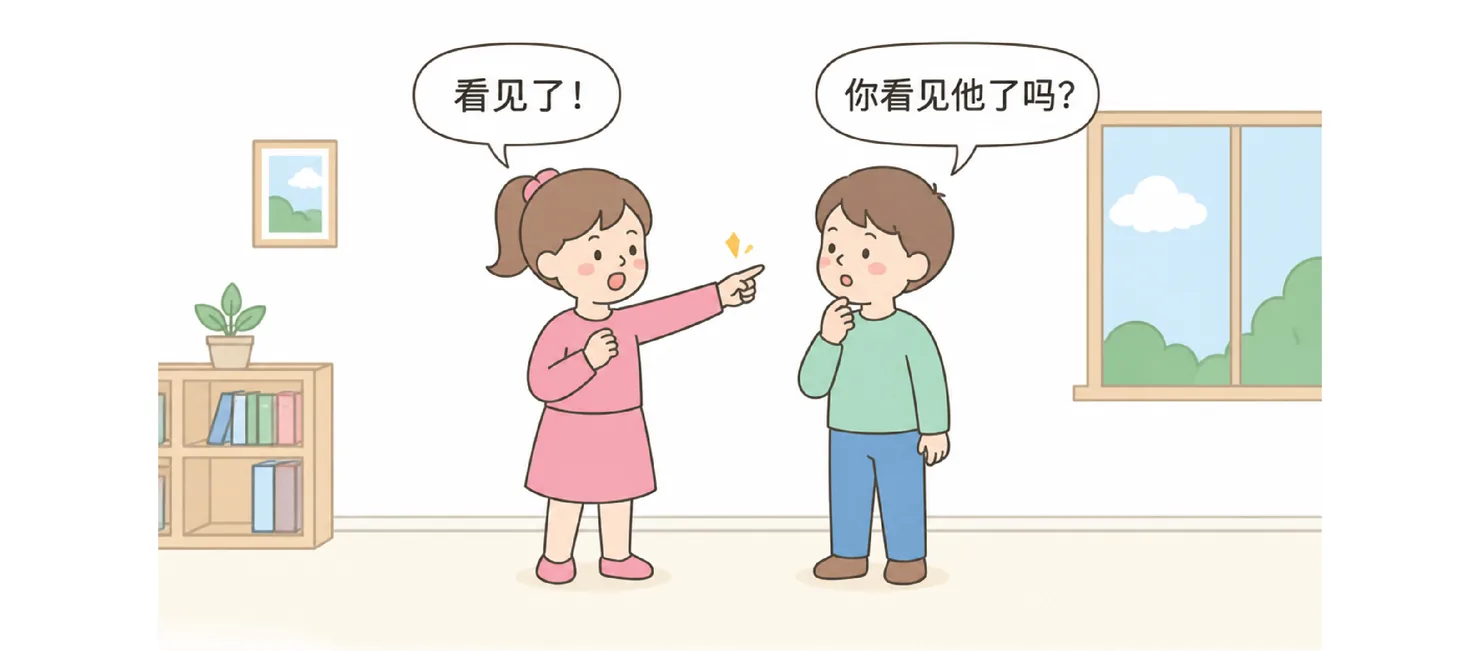 你看见他了吗?— 看见了!“Did you see him?” — “I see him!”
Key rule: 见 attaches only to sensory verbs. Learn 看见, 听见, 闻见, 梦见 as fixed words — 见 rarely appears outside them.
What 见 Adds to the Verb
Without 见 you are describing the activity of looking or listening; with 见 you are reporting that perception actually landed.
Without 见 = looking/listening; with 见 = you actually saw/heard it.
| Without 见 | Pinyin | With 见 | Pinyin | Difference |
|---|---|---|---|---|
| 我看他。 | Wǒ kàn tā. | 我看见他了。 | Wǒ kàn jiàn tā le. | looking at vs. saw |
| 我听音乐。 | Wǒ tīng yīnyuè. | 我听见音乐了。 | Wǒ tīng jiàn yīnyuè le. | listening vs. heard |
Which Verbs Pair with 见
见 attaches to the senses, and to little else. Each pairing names the sense that did the perceiving.
见 pairs only with sensory verbs — four common combinations.
| Verb + 见 | Pinyin | English | Sense |
|---|---|---|---|
| 看见 | kàn jiàn | see | sight |
| 听见 | tīng jiàn | hear | hearing |
| 闻见 | wén jiàn | smell | smell |
| 梦见 | mèng jiàn | dream about / see in a dream | dream imagery |
Compatibility: 见 works only with sensory perception verbs. Non-sensory verbs are blocked — ❌ 写见 (xiě jiàn), ❌ 吃见 (chī jiàn), ❌ 做见 (zuò jiàn) — because writing, eating and doing involve no perception.
Core Examples
| Chinese | Pinyin | English | Context |
|---|---|---|---|
| 你看见他了吗? | Nǐ kàn jiàn tā le ma? | Did you see him? | visual perception |
| 我听见有人在唱歌。 | Wǒ tīng jiàn yǒurén zài chànggē. | I hear someone singing. | auditory perception |
| 你闻见香味了吗? | Nǐ wén jiàn xiāngwèi le ma? | Can you smell the fragrance? | smell |
| 昨晚我梦见你了。 | Zuówǎn wǒ mèng jiàn nǐ le. | I dreamed about you last night. | dream |
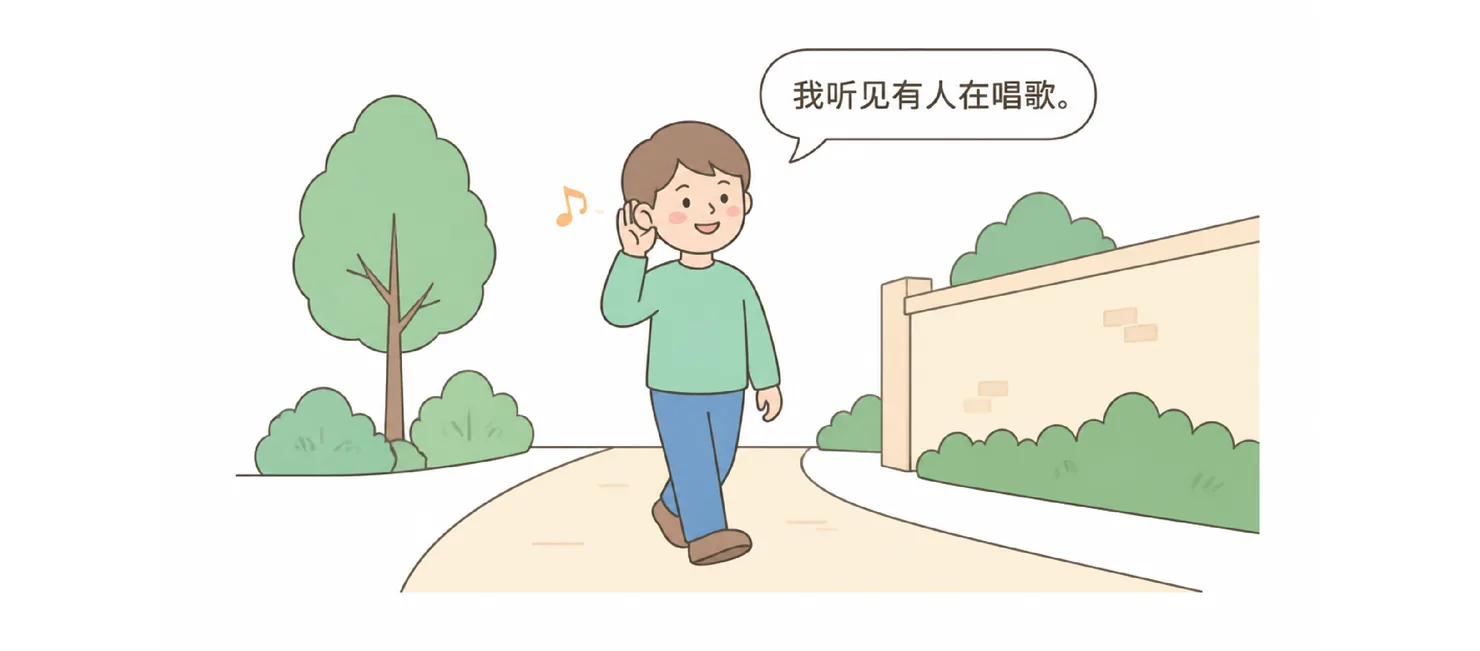 我听见有人在唱歌 — “I hear someone singing.”
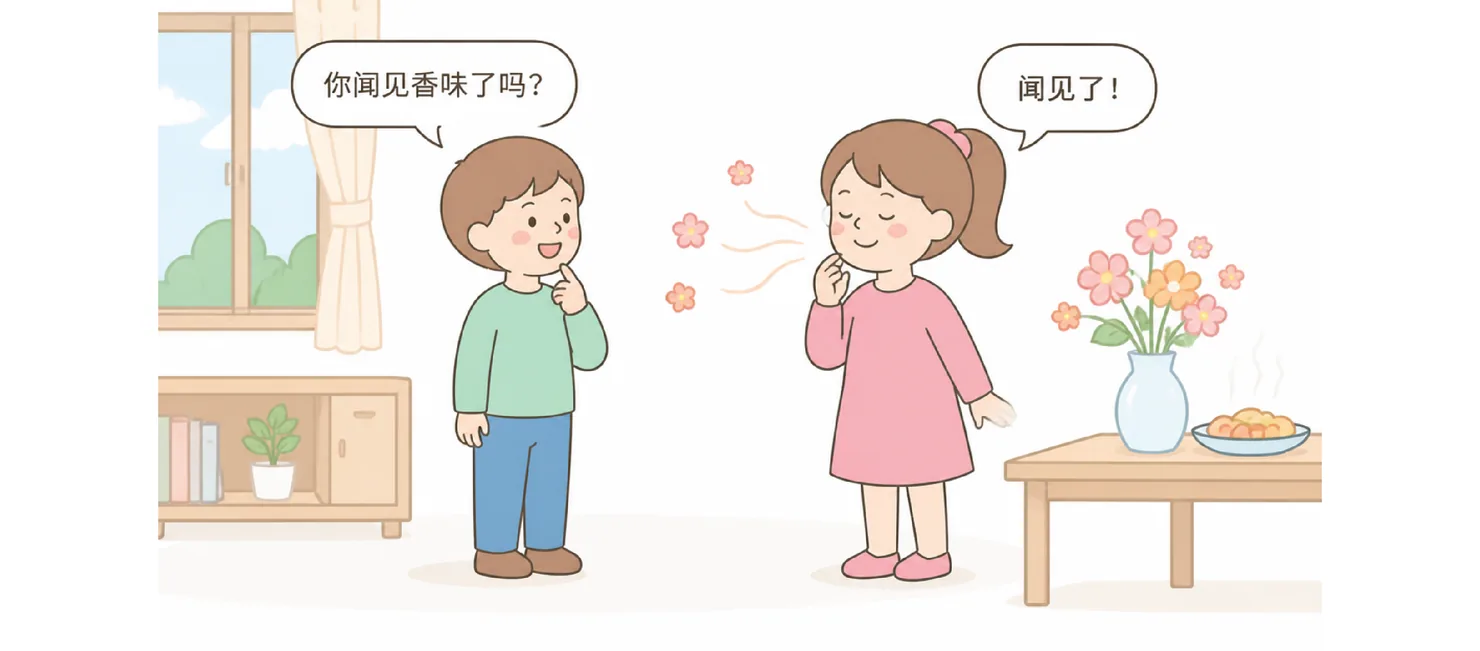 你闻见香味了吗?— 闻见了!“Can you smell the fragrance?” — “I can smell it!”
Nuance 1 — 看见 vs. 看到
This is the classic 见 question. Both mean "see," and in practice they are often interchangeable. The difference is where the emphasis falls: 看见 stresses that your eyes perceived it; 看到 stresses that the looking succeeded in reaching its target.
看见 stresses the sensory act; 看到 stresses succeeding at the goal. Often interchangeable.
| Complement | Emphasis | Chinese | Pinyin | English |
|---|---|---|---|---|
| 见 | the sensory act itself | 我看见他了。 | Wǒ kàn jiàn tā le. | I saw him. (my eyes perceived him) |
| 到 | the successful outcome | 我看到他了。 | Wǒ kàn dào tā le. | I saw him. (I succeeded in seeing him) |
| Situation | Better choice | Why |
|---|---|---|
| You saw someone unexpectedly | 看见 | emphasizes sensory perception |
| You searched for someone and saw them | 看到 | emphasizes the successful search |
| You caught a glimpse of something | 看见 | emphasizes the sensory act |
| You actively looked and found it | 看到 | emphasizes the successful outcome |
Rule of thumb: unexpected or spontaneous perception → 看见. Actively sought → 看到.
Nuance 2 — Nothing Comes Between the Verb and 见
| Chinese | Pinyin | English | |
|---|---|---|---|
| ✅ Correct | 我看见他了。 | Wǒ kàn jiàn tā le. | I saw him. |
| ❌ Incorrect | 我看了见他。 | Wǒ kàn le jiàn tā. | 了 cannot separate 看 and 见. |
Negation — Use 没, Not 不
| Chinese | Pinyin | English | |
|---|---|---|---|
| ✅ Correct | 我没看见他。 | Wǒ méi kàn jiàn tā. | I didn’t see him. |
| ❌ Incorrect | 我不看见他。 | Wǒ bù kàn jiàn tā. | 没 is for completed actions, not 不. |
| Chinese | Pinyin | English | |
|---|---|---|---|
| ✅ Correct | 我没听见你说话。 | Wǒ méi tīng jiàn nǐ shuōhuà. | I didn’t hear you speaking. |
| ❌ Incorrect | 我不听见你说话。 | Wǒ bù tīng jiàn nǐ shuōhuà. | 没 is for completed actions, not 不. |
The one place 不 appears: the potential form — 看不见 (kàn bu jiàn, cannot see), 听不见 (tīng bu jiàn, cannot hear). Positive: 看得见 (kàn de jiàn, can see).
Quick Reference
| Point | Summary |
|---|---|
| Meaning | 见 = a sense successfully perceived something |
| Attachment | directly after the verb — nothing in between |
| Verb range | sensory verbs only: 看, 听, 闻, 梦 |
| Negation | 没 for completed actions; 不 only in the potential form |
| 见 vs 到 | 见 = the sensory act · 到 = reaching the target |
| Fixed words | 看见, 听见, 闻见, 梦见 — learn as vocabulary |
Drills
Fill in the correct result complement. Choose from 见 / 到 / 懂 / 清楚. Each question’s English meaning is the hint.
- 你看___他了吗?(Did you see him?)
- 我听___有人在唱歌。(I hear someone singing.)
- 你闻___香味了吗?(Can you smell the fragrance?)
- 昨晚我梦___你了。(I dreamed about you last night.)
- 我没听___你说话。(I didn’t hear you speaking.)
- 远处好像有人——你看___了吗?(Did you see them?)
- 我没看___他,他已经走了。(I didn’t see him.)
- 我买___票了!(I managed to get tickets!)
- 你找___钥匙了吗?(Did you find the keys?)
- 他收___了很多礼物。(He received many gifts.)
- 你听___了吗?(Did you understand by listening?)
- 请你说___,我没听清。(Please say it clearly.)
Answer Key: 1. 见 2. 见 3. 见 4. 见 5. 见 6. 见 7. 见 8. 到 9. 到 10. 到 11. 懂 12. 清楚
Notes
- 看见 and 听见 are by far the most common; treat all four V+见 pairs as single vocabulary items.
- 见 is unusually restricted — unlike most complements it attaches to only a handful of verbs.
- 梦见 extends the “perception” idea to dreams: what you “saw” while asleep.
- For the goal-reaching sense, compare 到; for the whole family see result complements.
Sources
HSK Standard Course 2 — L9 (结果补语, result complements introduced) HSK Standard Course 3 — L6 (V得/不 + RC, potential form)