Compound Directional Complements
Overview
Compound directional complements describe movement in relation to the speaker's perspective. They combine a motion verb (走, 跑, 拿…) with a directional verb (上, 下, 进, 出, 回, 过) and then 来 or 去 to show whether something moves toward or away from the speaker's current position. Unlike English, where "come" and "go" can be used loosely, Chinese is strict: the choice of 来 or 去 is always anchored to where the speaker is physically standing at the moment of speaking. This page covers all six direction pairs, how to match the correct verb group, when 把 is required, and the structural difference between objects and locations.
Combines a motion verb + directional verb + 来/去 to show movement toward or away from the speaker. The choice of 来 vs 去 is always based on the speaker's current position.
Pattern(s)
Motion Verb + Direction Verb + 来/去- 来 → movement toward the speaker’s current position
- 去 → movement away from the speaker’s current position
The six base directional verbs pair with 来 and 去 to form twelve compound directional complements:
| Compound | Pinyin | Meaning | Example | Pinyin | English |
|---|---|---|---|---|---|
| 上来 | shànglái | come up (toward speaker) | 他走上来了。 | Tā zǒu shànglái le. | He came up. |
| 上去 | shàngqù | go up (away from speaker) | 他走上去了。 | Tā zǒu shàngqù le. | He went up. |
| 下来 | xiàlái | come down (toward speaker) | 跑下来! | Pǎo xiàlái! | Come running down! |
| 下去 | xiàqù | go down (away from speaker) | 他走下去了。 | Tā zǒu xiàqù le. | He walked down. |
| 进来 | jìnlái | come in (toward speaker) | 请进来。 | Qǐng jìnlái. | Please come in. |
| 进去 | jìnqù | go in (away from speaker) | 他走进去了。 | Tā zǒu jìnqù le. | He walked in. |
| 出来 | chūlái | come out (toward speaker) | 她从房间出来了。 | Tā cóng fángjiān chūlái le. | She came out of the room. |
| 出去 | chūqù | go out (away from speaker) | 他跑出去了。 | Tā pǎo chūqù le. | He ran out. |
| 回来 | huílái | come back (toward speaker) | 快回来! | Kuài huílái! | Come back quickly! |
| 回去 | huíqù | go back (away from speaker) | 你回去工作。 | Nǐ huíqù gōngzuò. | Go back to work. |
| 过来 | guòlái | come over (toward speaker) | 你过来一下。 | Nǐ guòlái yīxià. | Come here a moment. |
| 过去 | guòqù | go over (away from speaker) | 他走过去了。 | Tā zǒu guòqù le. | He walked over. |
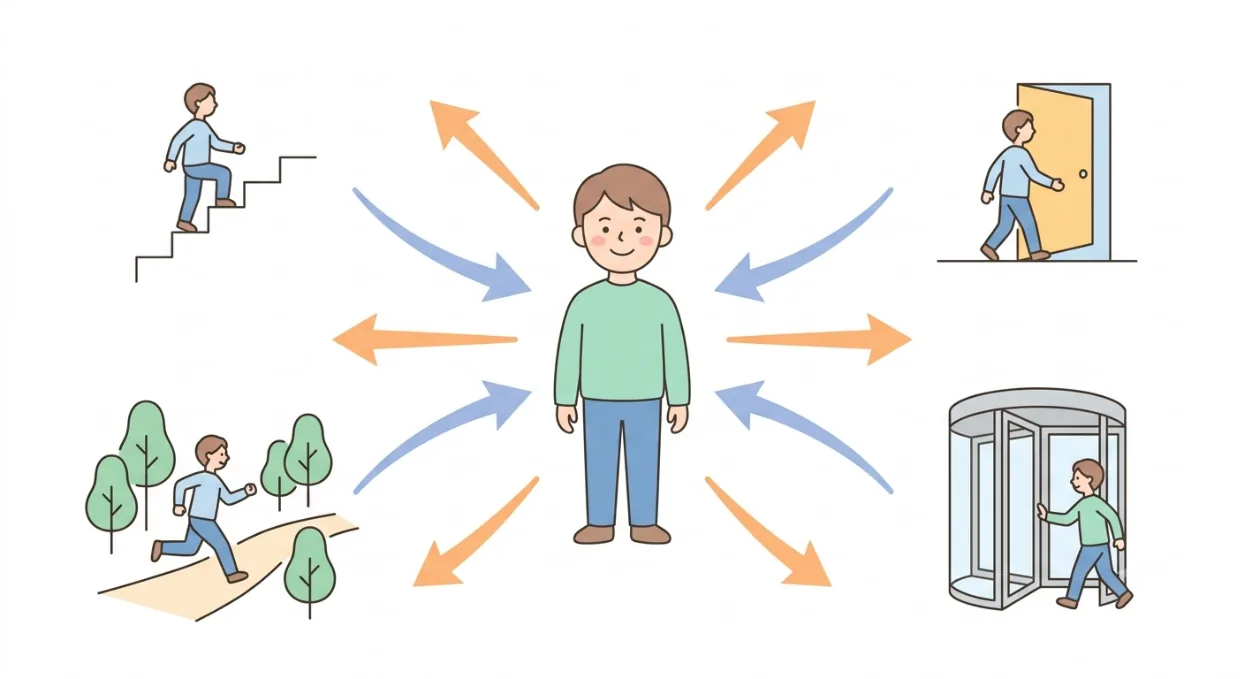
1. Core Structure — Present, Past, Future
Before you can use compound directional complements correctly, you need to understand where they sit in a sentence. Unlike English, which changes the verb form to mark tense ("came in" vs "come in"), Chinese keeps the verb and complement completely unchanged. Time is shown instead by small signals: time words (今天, 刚才, 明天) or the completion particle 了. The critical point is where 了 goes — it always follows the entire complement, never between the verb and the directional part.
The complement never changes form. Mark time with 了 or a time word. 了 always goes after the full complement — never between the verb and direction.
Key rule: Never separate the verb from its directional complement — and never place 了 between them. ❌ 她跑了上来 → ✅ 她跑上来了
| Tense | Structure | Chinese | Pinyin | English |
|---|---|---|---|---|
| Past (completed) | Verb + Complement + 了 | 她跑上来了。 | Tā pǎo shànglái le. | She ran up (toward speaker). |
| Present / habitual | Verb + Complement | 她跑上来。 | Tā pǎo shànglái. | She runs up (toward speaker). |
| Future | 会 + Verb + Complement | 她会跑上来。 | Tā huì pǎo shànglái. | She will run up (toward speaker). |
Note on 了: 了 follows the complete compound (verb + direction verb + 来/去). You will sometimes hear 她跑上来了 and sometimes 她跑上来 — the presence of 了 signals the action is completed from the speaker’s perspective, not just that it happened.
Note on 了: 了 marks the action as completed from the speaker’s perspective — not simply that it happened.
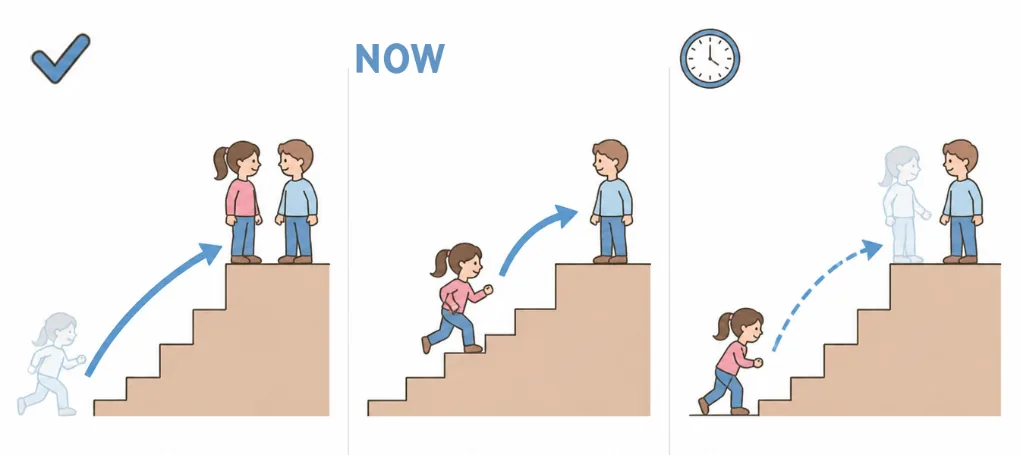
2. Matching Verbs to Direction Groups
In Chinese, the directional complement tells you not only which direction something is moving, but also what type of verb is needed. Not every motion verb fits naturally with every direction group. A simple way to figure out which complement works is to ask yourself: Is my whole body moving through space, or am I using my hands to move something else? Body movement verbs (走, 跑, 爬, 飞, 跳) work with direction groups that describe whole-body travel through space. Hand movement verbs (拿, 送, 搬, 递, 倒) describe using your hands — or your physical effort — to cause an object to travel, and they work with direction groups that imply object handling. When you learn a new motion verb, categorise it immediately into one of these two groups.
Ask: am I moving my body, or moving an object with my hands? Body verbs and hand verbs pair with different directional complements.
| Direction group | Compatible verbs (manner) | Example | Pinyin | English |
|---|---|---|---|---|
| 上来 / 上去 | 走, 跑, 爬, 拿, 送, 搬, 飞 | 爬上来 | Pá shànglái | Climb up (toward speaker) |
| 下来 / 下去 | 跑, 走, 坐, 掉, 拿, 送 | 走下来 | Zǒu xiàlái | Walk down (toward speaker) |
| 进来 / 进去 | 走, 跑, 搬, 放, 飞, 冲 | 飞进来 | Fēi jìnlái | Fly in (toward speaker) |
| 出来 / 出去 | 跑, 拿, 走, 搬, 倒, 冲 | 冲出去 | Chōng chūqù | Burst out (away from speaker) |
| 回来 / 回去 | 走, 跑, 寄, 飞, 送, 开 | 寄回来 | Jì huílái | Send back (toward speaker) |
| 过来 / 过去 | 走, 跑, 扔, 递, 开, 游 | 开过来 | Kāi guòlái | Drive over (toward speaker) |
Key rule:
- Use the 去 series (上去, 下去, 进去…) when the movement is going away from the speaker.
- Use the 来 series (上来, 下来, 进来…) when the movement is coming toward the speaker.
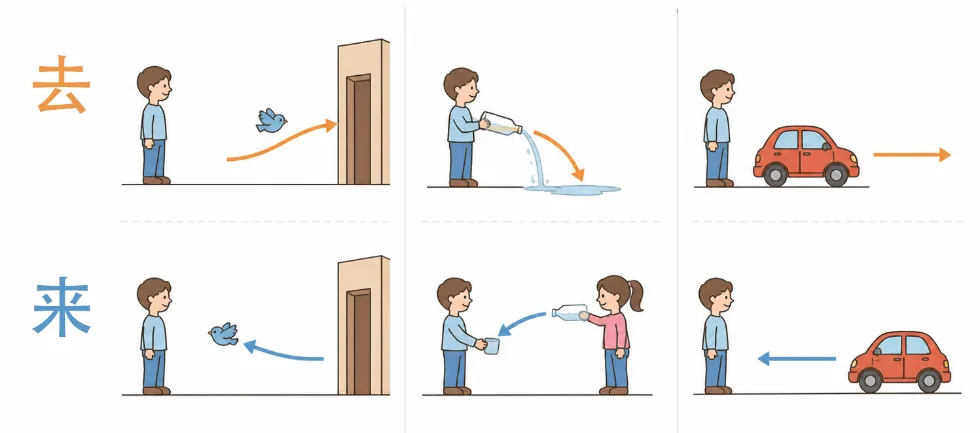
3. Speaker’s Location — Far vs. Close to the Action
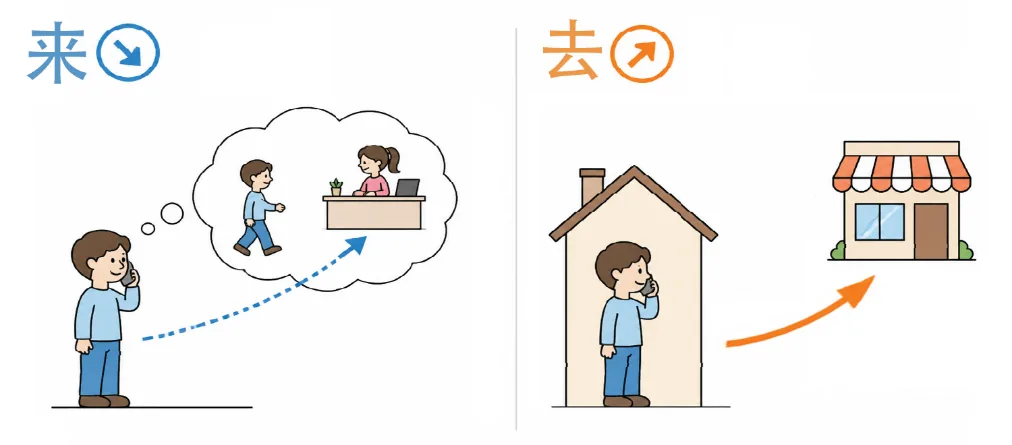
This is the single most important conceptual shift for English speakers. In English, "come" and "go" are somewhat flexible — you can say "I'm coming to your house" even when you are not yet there. Chinese is strict: the choice between the 来 series (toward speaker) and the 去 series (away from speaker) depends entirely on the speaker's physical location at the moment of speaking — not on the destination, not on logical intent, and not on the direction the subject is physically facing.
来 or 去 is determined solely by where the speaker is standing right now — not by the destination or the direction of movement.
| Speaker’s position | Movement direction | Correct complement | Chinese | Pinyin | English |
|---|---|---|---|---|---|
| Inside the room | Someone comes in | 进来 | 请进来! | Qǐng jìnlái! | Please come in! |
| Inside the room | Someone goes out | 出去 | 他出去了。 | Tā chūqù le. | He went out. |
| Outside the room | Someone comes out | 出来 | 快出来! | Kuài chūlái! | Come out quickly! |
| Outside the room | Someone goes in | 进去 | 他进去了。 | Tā jìnqù le. | He went in. |
| Upstairs | Friend comes up | 上来 | 你上来吧。 | Nǐ shànglái ba. | Come up. |
| Downstairs | Friend goes up | 上去 | 他上去了。 | Tā shàngqù le. | He went up. |
Imagine you are standing downstairs. Someone calls you from upstairs. You say: 你下来!(Nǐ xiàlái!) — “Come down!” because the movement is coming toward you.
Now imagine you are upstairs. The same person is downstairs. You say: 你下去!(Nǐ xiàqù!) — “Go down!” because the movement is going away from you.
The physical movement is identical — someone walks downstairs. Only the speaker’s location changes, and that alone determines whether 来 or 去 is used.
The same physical movement — someone walking downstairs — takes 下来 when you are downstairs (toward you) and 下去 when you are upstairs (away from you). Only your position changes.
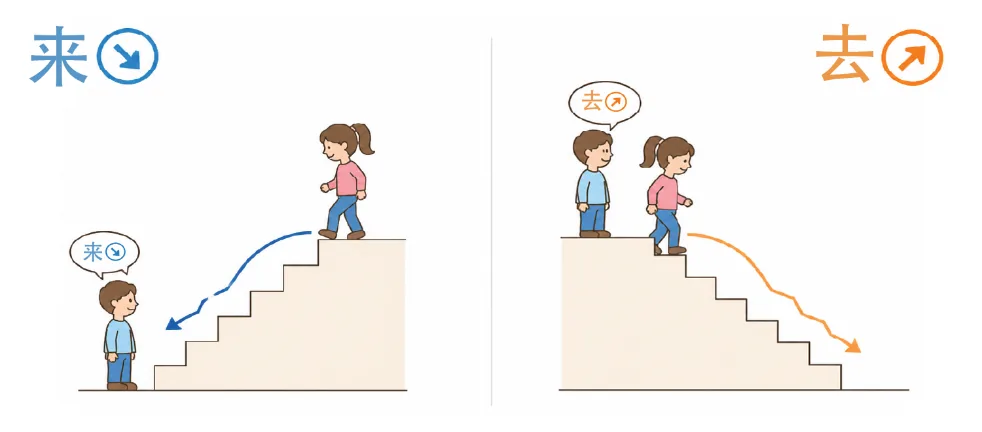
🔑 Strong Example — 下来: Speaker is downstairs. A friend is upstairs. 你从楼上下来吧!(Nǐ cóng lóushàng xiàlái ba!) — “Come downstairs!” (movement comes toward the speaker)
🔑 Strong Example — 下去: Speaker is upstairs. A friend is also upstairs. 你先下去,我一会儿就来。(Nǐ xiān xiàqù, wǒ yīhuìr jiù lái.) — “You go down first, I’ll be there in a moment.” (movement goes away from the speaker)
This rule also applies metaphorically. If you are on the phone with someone and you say “I’m coming to your office,” in Chinese you would use 来 — even though you are not physically at the office yet. You are imagining your own future location (your friend’s office) as the reference point, so 来 is still correct. This is why 我来了 (Wǒ lái le) — “I’m coming!” or “I’m on my way!” — uses 来 even when you haven’t arrived: the destination is mentally treated as the speaker’s position. This kind of perspective-shifting is rare and context-dependent, but it explains why certain expressions feel counterintuitive to English speakers at first.
来/去 can apply metaphorically too: 我来了 ("I'm on my way!") uses 来 even before arriving, because the destination is mentally treated as the speaker's position.
4. Using 把 with Compound Directional Complements
The 把 structure is not always required when using compound directional complements, but it becomes very useful — and sometimes necessary — when the object you are moving is definite, specific, or described by a long phrase. Without 把, the structure is neutral and the object typically follows the full directional complement. When the object is something specific ("that book," "my phone," "the red chair from the corner"), placing it after the complement becomes grammatically awkward. 把 solves this by moving the object before the verb, making the sentence cleaner and placing explicit focus on the object being handled.
Use 把 when the object is definite or complex. 把 moves the object before the verb for clarity. Mandatory with long or specific objects.
See also: 把字句 (bǎ zì jù) — the full 把 grammar page covers all three disposal structures in depth.
Rules for 把 with directional complements:
- 把 is mandatory when the object is definite or specific (那本书, 我的手机, 桌上的那把椅子)
- Without 把: Subject + Verb + Directional Complement + Object (neutral — object follows) With 把: Subject + 把 + Object + Verb + Directional Complement (object-focused — object leads)
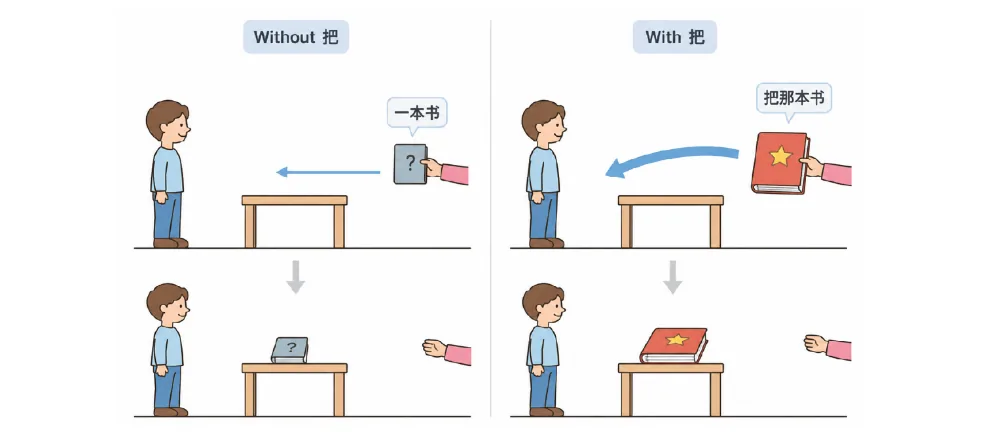
The 把 structure moves the object forward in the sentence, which allows the verb to be followed immediately by the directional complement without interruption. This is especially helpful when the object is long, modified by a relative clause, or when you want to make completely clear which specific item is being acted on.
把 moves the object before the verb, keeping the complement uninterrupted — essential when the object is long or clause-modified.
| Without 把 (neutral) | With 把 (object-focused) | |
|---|---|---|
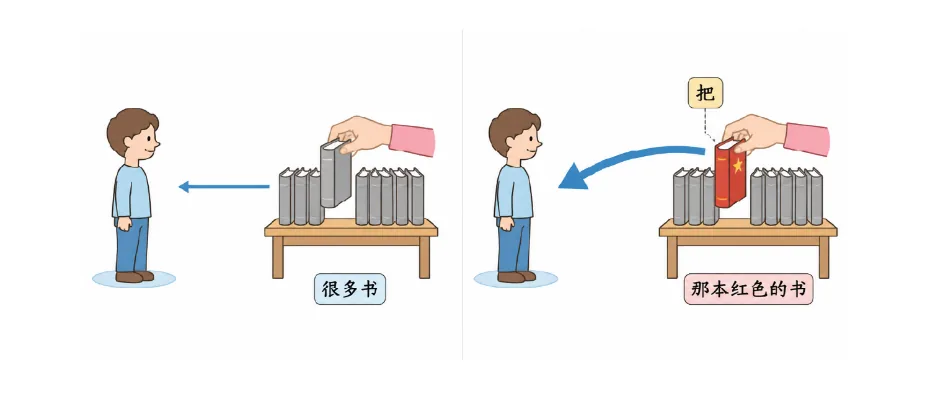
| Chinese | 拿一本书上来 | 把那本红色的、放在桌上的书拿上来 |
| Pinyin | Ná yī běn shū shànglái | Bǎ nà běn hóngsè de, fàng zài zhuōzi shàng de shū ná shànglái |
| English | Bring a book up here | That red book on the table — bring it up here |
| Note | Indefinite object, neutral tone | Long definite object — 把 is mandatory |
Another reason to use 把 is to give a sentence a more formal, instructional, or task-oriented tone. Even with shorter objects, 把 signals clearly that you are directing attention to a particular item and asking that it be handled in a specific way. This is why instructions and requests in Chinese often use 把 even when the object is not unusually long or complex — it makes the intent unambiguous.
把 also signals a formal or instructional tone — making intent clear even with shorter, simpler objects.
Here are three shorter but equally common patterns — notice how 把 makes the object the clear focus in each:
Three common 把 patterns:
| Without 把 | With 把 | |
|---|---|---|
| Chinese | 拿书上来 | 把书拿上来 |
| Pinyin | Ná shū shànglái | Bǎ shū ná shànglái |
| English | Bring books up | Bring the book up (focused) |
| Without 把 | With 把 | |
|---|---|---|
| Chinese | 送礼物回去 | 把礼物送回去 |
| Pinyin | Sòng lǐwù huíqù | Bǎ lǐwù sòng huíqù |
| English | Send a gift back | Send the gift back (focused) |
| Without 把 | With 把 | |
|---|---|---|
| Chinese | 搬椅子进来 | 把椅子搬进来 |
| Pinyin | Bān yǐzi jìnlái | Bǎ yǐzi bān jìnlái |
| English | Move a chair in | Move the chair in (focused) |
5. Object vs. Location — Structure Differences
One of the most persistent errors with compound directional complements is confusing how to position objects (things being moved) with how to specify locations (places where the movement happens). They are governed by completely different rules and cannot share the same position in a sentence.
Objects and locations follow entirely different placement rules and cannot go in the same position.
OBJECTS (what is being moved)
When your sentence contains an object — something being moved — its position depends on whether you are using 把 or not:
Object position depends on whether 把 is used:
- Neutral structure (no 把): Subject + Verb + Directional Complement + Object
她拿上来一本书。(Tā ná shànglái yī běn shū.) — She brought up a book.
- 把 structure (definite object): Subject + 把 + Object + Verb + Directional Complement
她把那本书拿上来了。(Tā bǎ nà běn shū ná shànglái le.) — She brought that book up.
Objects can never be placed between the direction verb and 来/去: ❌ 拿上书来 is wrong.
LOCATIONS (where the movement goes)
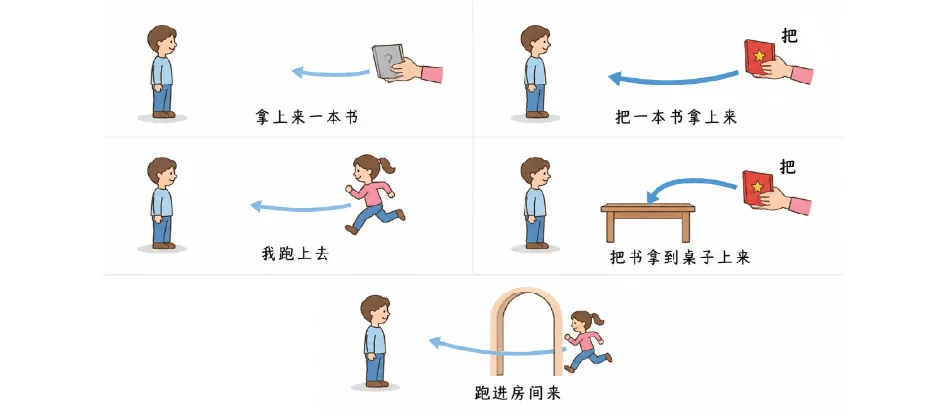
When you want to name the specific location the movement is directed into or toward (a room, a building, upstairs), the location does not follow the complete compound. Instead, it inserts between the direction verb and 来/去, splitting the compound:
Locations split the complement — they insert between the direction verb and 来/去, not after the complete compound:
- Location structure: Subject + Verb + Direction Verb + Location + 来/去
跑进房间来 (pǎo jìn fángjiān lái) — Run into the room (toward speaker) 搬进办公室去 (bān jìn bàngōngshì qù) — Move into the office (away from speaker)
| Sentence type | Structure | Chinese | Pinyin | English |
|---|---|---|---|---|
| Moving an object (no 把) | V + Dir Complement + Object | 拿上来一本书 | Ná shànglái yī běn shū | Bring up a book. |
| Moving an object (with 把) | 把 + Obj + V + Dir Complement | 把书拿上来 | Bǎ shū ná shànglái | Bring the book up. |
| Specifying a location | V + Direction Verb + Location + 来/去 | 跑进房间来 | Pǎo jìn fángjiān lái | Run into the room (toward speaker). |
| Object + location together | 把 + Obj + V + Dir Verb + Location + 来/去 | 把书拿进房间来 | Bǎ shū ná jìn fángjiān lái | Bring the book into the room. |
Critical difference:
1. OBJECTS — go after the complete complement (neutral) or before the verb with 把: ✅ 拿上来一本书 (neutral) / 把书拿上来 (把 structure) ❌ 拿上书来 (wrong — object cannot split the complement)
2. LOCATIONS — must always split the complement, inserting between the direction verb and 来/去: ✅ 跑进房间来 (location splits the complement correctly) ❌ 跑进来房间 (wrong — location cannot follow the complete compound)
6. Hand Movements vs. Body Movements
Chinese makes a clear grammatical distinction between two types of movement verbs, and understanding this distinction prevents the most common structural errors learners make with compound directional complements.
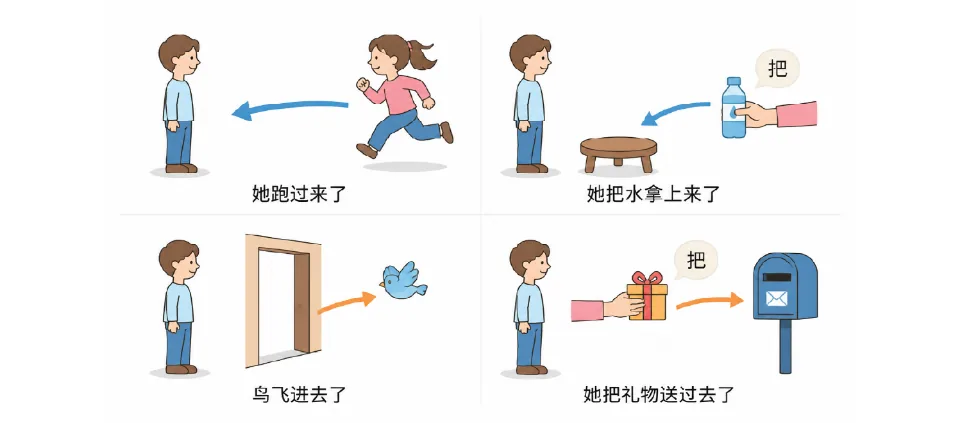
Body verbs (走, 跑) move the subject — no object possible. Hand verbs (拿, 送) move an object — object required, often needs 把.
Body movement verbs
Body movement verbs describe how the subject’s own body moves through space. The most common examples are 走 (to walk), 跑 (to run), 爬 (to climb), 跳 (to jump), 飞 (to fly), and 游 (to swim). These verbs cannot take a direct object because the subject itself is what is moving. When you combine them with a compound directional complement, the sentence tells you how and in what direction the subject travels — and nothing more.
走, 跑, 爬, 跳, 飞, 游 — the subject's own body moves. These verbs cannot take an object; the subject itself is what travels through space.
Hand movement verbs
Hand movement verbs describe using your hands — or more broadly, your physical capacity to handle something — to cause an object to move. Common examples are 拿 (to hold/take), 放 (to place), 递 (to pass/hand to someone), 搬 (to carry/move), 送 (to send/deliver), 寄 (to mail), and 倒 (to pour). These verbs require an object because what matters is not where the person goes, but what they are causing to travel. When the object is specific or definite, 把 is usually required.
拿, 放, 递, 搬, 送, 寄, 倒 — an object is moved using the hands or physical effort. An object is required; use 把 when the object is definite.
| Type | Verbs | Example | Pinyin | Meaning |
|---|---|---|---|---|
| Body movement | 走, 跑, 爬, 跳, 飞, 游 | 他跑进来了。 | Tā pǎo jìnlái le. | He ran in. (the person moves) |
| Hand movement | 拿, 放, 递, 搬, 送, 寄, 倒 | 把书拿上来。 | Bǎ shū ná shànglái. | Bring the book up. (the book moves) |
Clarification:
- Body movement + compound directional complement = the person moves through space.
- Hand movement + compound directional complement = an object moves through space.
Example pair:
| Chinese | Pinyin | English | What moves |
|---|---|---|---|
| 跑上楼来 | Pǎo shàng lóu lái | Come running upstairs | The person |
| 把水拿上楼来 | Bǎ shuǐ ná shàng lóu lái | Bring the water upstairs | The water |
Keeping these two verb groups clear prevents the most common structural error in this grammar point. A body movement verb cannot carry an object — ❌ 他把水跑上来了 is wrong because 跑 does not involve handling anything. The correct form is ✅ 他把水拿上来了.
Don't mix the two groups: ❌ 他把水跑上来了 is wrong — 跑 cannot carry an object. ✅ 他把水拿上来了 is correct — 拿 handles the object.
Quick Reference Chart
This chart is not just a review — it is the tool that most beginners need but rarely encounter. Many learners memorise 上来, 下去, and similar compounds as separate fixed phrases and then fail to adapt when the speaker’s position changes. The chart below organises all eight main compound direction pairs by where the speaker is standing, so you can immediately find the right complement for any situation.
The chart works by tracking two variables: where you (the speaker) are right now, and whether the movement is coming toward you or going away from you.
Find your position in the chart below, then choose 来 (toward you) or 去 (away from you).
| Speaker is… | Movement toward speaker (来 series) | Movement away from speaker (去 series) |
|---|---|---|
| Inside | 进来, 上来, 回来, 过来 jìnlái, shànglái, huílái, guòlái come in · come up · come back · come over |
出去, 下去, 回去, 过去 chūqù, xiàqù, huíqù, guòqù go out · go down · go back · go over |
| Outside | 出来, 上来, 过来 chūlái, shànglái, guòlái come out · come up · come over |
进去, 下去, 回去, 过去 jìnqù, xiàqù, huíqù, guòqù go in · go down · go back · go over |
| Upstairs | 上来, 过来 shànglái, guòlái come up · come over |
下去, 出去, 回去 xiàqù, chūqù, huíqù go down · go out · go back |
| Downstairs | 下来, 过来 xiàlái, guòlái come down · come over |
上去, 出去, 回去 shàngqù, chūqù, huíqù go up · go out · go back |
How to use this chart — step by step:
- Ask: Where am I (the speaker) right now?
- Find your row in the chart.
- Ask: Is the movement coming toward me, or going away from me?
- If toward you → choose from the 来 series column. If away from you → choose from the 去 series column.
The one rule that makes everything clear: 来 = toward the speaker (wherever I am right now) 去 = away from the speaker (wherever I am right now) Always ask: Where am I right now? — not where am I going, not where is the other person.
Drills
Fill in each blank with the correct compound directional complement:
- 她从楼上跑___了。(She came running down — you are downstairs)
- 请___!(Please come in! — you are inside)
- 他把那本书___了。(He brought that book up — you are downstairs)
- 快___!(Come back quickly! — movement toward you)
- 他冲___了。(He burst in — you are inside)
- 鸟飞___了。(The bird flew in — toward you, inside)
- 把椅子搬___。(Bring the chair in — toward you, inside)
- 你___工作吧。(Go back to work — movement away from you)
- 他跑___了。(He ran over — toward you)
- 她把信寄___了。(She sent the letter back — away from you)
- 爷爷慢慢地走___了。(Grandpa slowly came up — you are downstairs)
- 他从房间里冲___了。(He burst out of the room — toward you)
Answer Key: 1. 下来 2. 进来 3. 拿上来 4. 回来 5. 进来 6. 进来 7. 进来 8. 回去 9. 过来 10. 回去 11. 上来 12. 出来
Notes
- Tone reduction: In natural speech, 来 and 去 in compound directional complements are typically unstressed and their tones flatten — 来 approaches a neutral tone and 去 may sound shorter. This is standard and expected, not an error.
- Simple vs. compound directional complements: At HSK 2, 来 and 去 alone can attach to motion verbs as simple directional complements (走来, 跑去). The compound forms covered here (上来, 进去…) extend this at HSK 3 by inserting the directional verb between the motion verb and 来/去.
Sources
HSK Standard Course 2 — directional complement foundations: simple 来/去 series attached to motion verbs
HSK Standard Course 3 — compound directional complements: 上来/下去/进来 series, speaker perspective rules, 把 structure, object vs. location placement, body vs. hand movement verbs