饱 as a Result Complement — Full from Eating
Overview
饱 (bǎo) is a result complement meaning a person has reached satiety from eating or drinking. 吃饱 is "eat one's fill / be full," 喝饱 is "drink one's fill." What makes 饱 special is grammatical, not just culinary: it is one of the few result complements that describes a state of the subject — the person who ate — rather than the object. When you say 我吃饱了, the fullness belongs to you, not to the food. It shares this trait with 累.
饱 (bǎo) says the eater is full: 吃饱, 喝饱. Unusually, it describes the subject's state, not the object's.
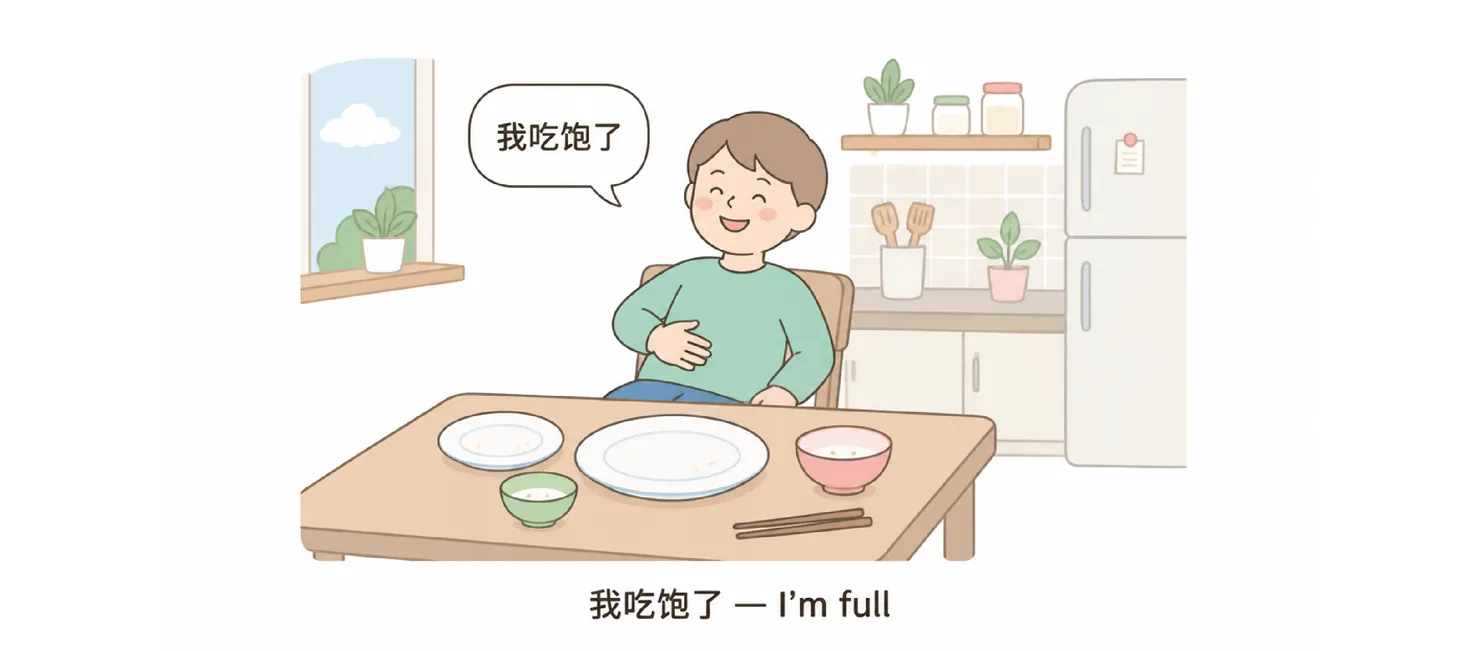 我吃饱了 — “I’m full.” The state belongs to the speaker, not the food.
Key rule: 饱 attaches only to eating and drinking verbs, and the fullness describes the person, not what was eaten.
What 饱 Adds to the Verb
| Without 饱 | Pinyin | With 饱 | Pinyin | Difference |
|---|---|---|---|---|
| 我吃饭了。 | Wǒ chī fàn le. | 我吃饱了。 | Wǒ chī bǎo le. | ate vs. am full |
| 他喝了汤。 | Tā hē le tāng. | 他喝饱了。 | Tā hē bǎo le. | drank soup vs. drank his fill |
Which Verbs Pair with 饱
饱 has an unusually narrow range — it attaches essentially to two verbs. This makes it one of the easiest complements to master.
饱 attaches to just 吃 and 喝 — a very small set.
| Verb + 饱 | Pinyin | English |
|---|---|---|
| 吃饱 | chī bǎo | eat one’s fill / be full from eating |
| 喝饱 | hē bǎo | drink one’s fill |
Compatibility: 饱 works only with consuming verbs. Anything else is blocked — ❌ 走饱 (zǒu bǎo), ❌ 看饱 (kàn bǎo) — since walking and looking cannot make you full.
Core Examples
| Chinese | Pinyin | English | Context |
|---|---|---|---|
| 你吃饱了吗? | Nǐ chī bǎo le ma? | Are you full? | after a meal |
| 我吃饱了。 | Wǒ chī bǎo le. | I’m full. | declining more food |
| 他没吃饱。 | Tā méi chī bǎo. | He isn’t full / didn’t eat enough. | still hungry |
| 孩子喝饱了,睡着了。 | Háizi hē bǎo le, shuìzháo le. | The child drank his fill and fell asleep. | drinking |
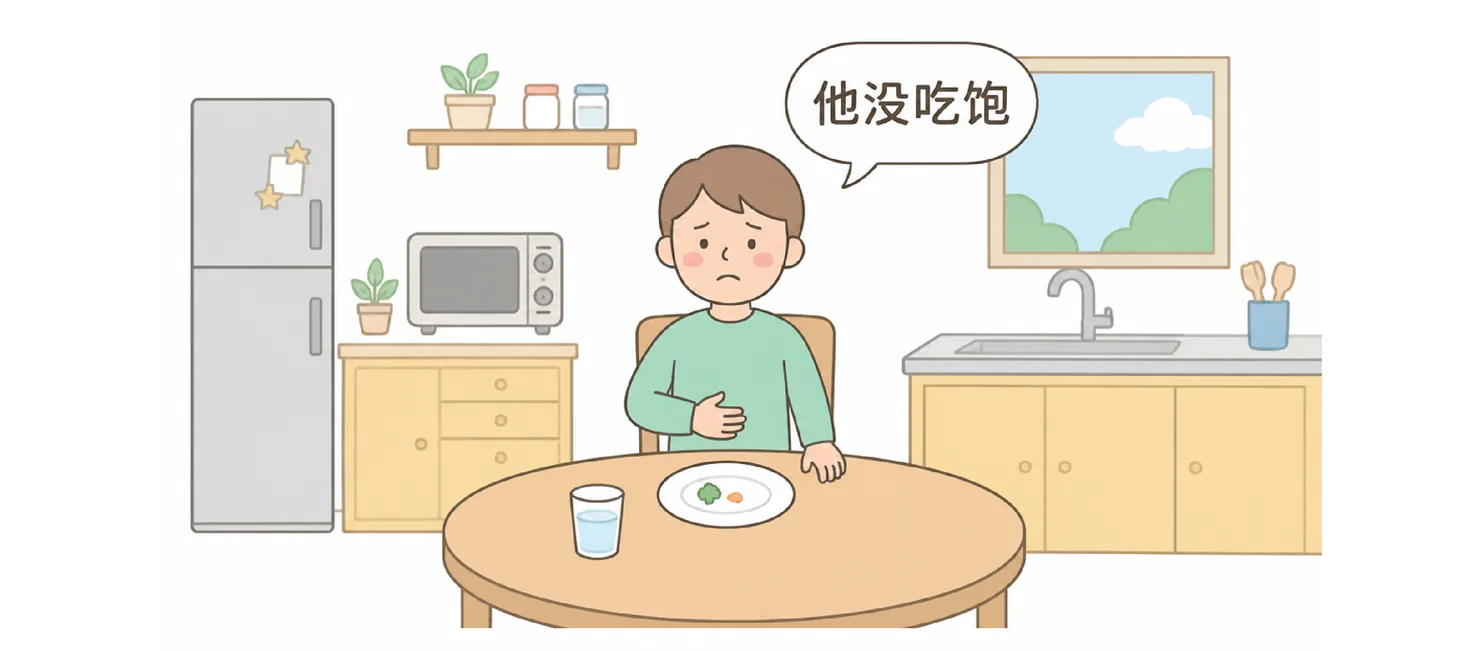 他没吃饱 — “He isn’t full.” Negation uses 没, never 不.
Nuance 1 — 饱 Describes the Eater, Not the Food
Most result complements report what happened to the object: 吃完饭 means the meal got finished. 饱 flips this — it reports the state of the subject. This is why 我吃饱了 and 我吃完了 are not interchangeable: one says you are full, the other says the food is gone.
吃饱 = you are full. 吃完 = the food is finished. Different subjects of the result.
| Chinese | Pinyin | English | Whose state? |
|---|---|---|---|
| 我吃饱了。 | Wǒ chī bǎo le. | I’m full. | the person |
| 我吃完了。 | Wǒ chī wán le. | I finished eating (it’s all gone). | the food |
In practice: you can be 吃饱 without being 吃完 (full, but food remains), and 吃完 without being 吃饱 (plate empty, still hungry).
Nuance 2 — 吃饱了 Is a Polite Refusal
At a Chinese table, 我吃饱了 is the standard, polite way to decline more food. It signals satisfaction rather than dislike, which makes it far more graceful than saying you don't want any more.
我吃饱了 is the polite way to decline more food.
| Chinese | Pinyin | English |
|---|---|---|
| 谢谢,我吃饱了。 | Xièxie, wǒ chī bǎo le. | Thank you, I’m full. |
| 我吃饱了,不用再给我了。 | Wǒ chī bǎo le, bùyòng zài gěi wǒ le. | I’m full — no need to give me more. |
Nuance 3 — Nothing Comes Between the Verb and 饱
| Chinese | Pinyin | English | |
|---|---|---|---|
| ✅ Correct | 我吃饱了。 | Wǒ chī bǎo le. | I’m full. |
| ❌ Incorrect | 我吃了饱。 | Wǒ chī le bǎo. | 了 cannot separate 吃 and 饱. |
Negation — Use 没, Not 不
| Chinese | Pinyin | English | |
|---|---|---|---|
| ✅ Correct | 他没吃饱。 | Tā méi chī bǎo. | He isn’t full. |
| ❌ Incorrect | 他不吃饱。 | Tā bù chī bǎo. | 没 is for completed actions, not 不. |
The one place 不 appears: the potential form — 吃不饱 (chī bu bǎo, can’t get full, e.g. the portion is too small). Positive: 吃得饱 (chī de bǎo, can eat one’s fill).
Quick Reference
| Point | Summary |
|---|---|
| Meaning | 饱 = full / satisfied from eating or drinking |
| Whose state | the subject (the eater), not the object |
| Verb range | 吃, 喝 only |
| Negation | 没吃饱; 不 only in the potential form 吃不饱 |
| 饱 vs 完 | 饱 = the person is full · 完 = the food is finished |
Drills
Fill in the correct result complement. Choose from 饱 / 完 / 好 / 累. Each question’s English meaning is the hint.
- 你吃___了吗?(Are you full?)
- 我吃___了,不用再给我了。(I’m full — no more for me.)
- 他没吃___。(He isn’t full.)
- 孩子喝___了,睡着了。(The child drank his fill and fell asleep.)
- 谢谢,我吃___了。(Thank you, I’m full.)
- 我没吃___,还想再吃一点儿。(I’m not full — I’d like a bit more.)
- 我吃___饭了,我们走吧。(I finished eating — let’s go.)
- 票都卖___了。(The tickets are all sold out.)
- 饭已经做___了。(The meal is ready.)
- 你准备___了吗?(Are you ready?)
- 我走___了,想坐一会儿。(I’m tired from walking.)
- 他跑___了。(He’s tired from running.)
Answer Key: 1. 饱 2. 饱 3. 饱 4. 饱 5. 饱 6. 饱 7. 完 8. 完 9. 好 10. 好 11. 累 12. 累
Notes
- 饱 has one of the smallest verb ranges of any result complement — essentially 吃 and 喝.
- 吃饱 vs 吃完 is the contrast worth drilling: full person vs. finished food.
- 吃不饱 (“can’t get full”) is useful for describing portions that are too small.
- 饱 and 累 are the two complements describing the subject’s own state; for the whole family see result complements.
Sources
HSK Standard Course 3 — 结果补语 (饱) HSK Standard Course 2 — L9 (结果补语, result complements introduced) HSK Standard Course 3 — L6 (V得/不 + RC, potential form)