好 as a Result Complement — Done Properly / Ready
Overview
好 (hǎo) as a result complement means an action has been successfully completed to a satisfactory state. When you attach 好 to a verb, you are telling the listener that the action resulted in readiness — the task is done, the outcome is satisfactory, and the result is ready to be used. It corresponds to English "done," "ready," or "properly." The single most important thing to grasp: this 好 is not the adjective 好 meaning "good." 准备好了 means "fully prepared," not "prepared nicely."
好 (hǎo) says an action is done properly and now ready — not the adjective 好 "good." 准备好了 = "fully ready."
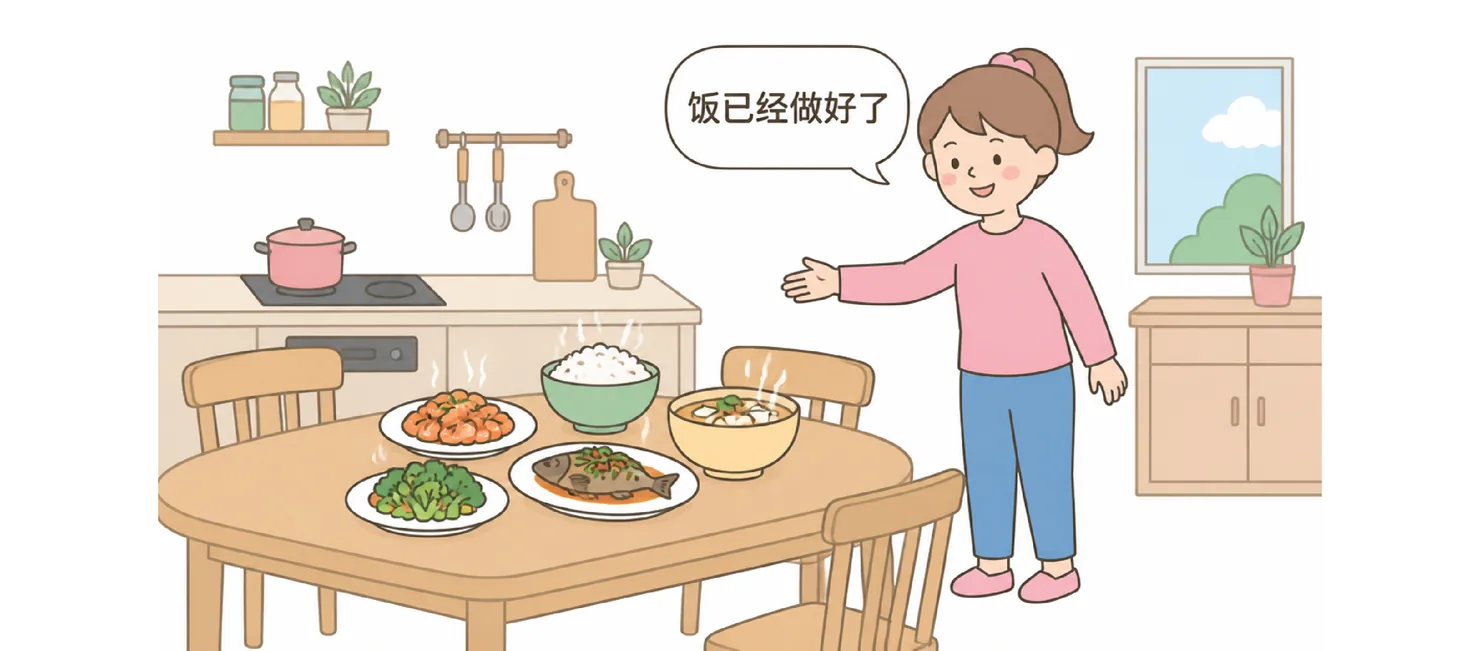 饭已经做好了 — “The meal is ready.” The food isn’t just cooked; it’s ready to eat.
Key rule: 好 attaches directly to the verb, and 了 is very commonly added to confirm the ready state: 准备好了, 做好了, 写好了.
What 好 Adds to the Verb
Without 好, the sentence names the action; with 好, it reports a finished, usable result. Compare the pairs below — the difference is between doing something and having it ready.
Without 好 = the action; with 好 = the result is ready.
| Without 好 | Pinyin | With 好 | Pinyin | Difference |
|---|---|---|---|---|
| 我准备了。 | Wǒ zhǔnbèi le. | 我准备好了。 | Wǒ zhǔnbèi hǎo le. | preparing vs. ready |
| 信写了。 | Xìn xiě le. | 信写好了。 | Xìn xiě hǎo le. | writing vs. ready to send |
The Five Shades of 好
好 carries one core idea — successful completion to a satisfactory state — which shows up in several everyday forms depending on the verb.
One core idea (done to a satisfactory, ready state) across five common verb types.
| Shade | What it means | Example |
|---|---|---|
| Preparation | getting something ready | 准备好 zhǔnbèi hǎo — get ready |
| Creation | making something properly | 做好 zuò hǎo — finish doing; 写好 xiě hǎo — write properly |
| Arrangement | organizing something properly | 安排好 ānpái hǎo — arrange properly |
| Decision | thinking through and deciding | 想好 xiǎng hǎo — decide, think through |
| Repair | fixing something successfully | 修好 xiū hǎo — repair successfully |
Which Verbs Pair with 好
| Verb + 好 | Pinyin | English | Verb + 好 | Pinyin | English |
|---|---|---|---|---|---|
| 做好 | zuò hǎo | finish doing (properly) | 安排好 | ānpái hǎo | arrange properly |
| 准备好 | zhǔnbèi hǎo | get ready | 想好 | xiǎng hǎo | think through / decide |
| 写好 | xiě hǎo | write properly / finish writing | 约好 | yuē hǎo | make an appointment |
| 画好 | huà hǎo | finish drawing | 说好 | shuō hǎo | agree on |
| 修好 | xiū hǎo | repair successfully | 放好 | fàng hǎo | put in its place |
Compatibility: 好 needs a verb that can produce a “ready” or “properly done” state. It does not attach to verbs with no such endpoint — ❌ 喜欢好 (xǐhuān hǎo), ❌ 知道好 (zhīdào hǎo).
Core Examples
| Chinese | Pinyin | English | Context |
|---|---|---|---|
| 饭已经做好了。 | Fàn yǐjīng zuò hǎo le. | The meal is ready. | meal preparation |
| 你准备好了吗? | Nǐ zhǔnbèi hǎo le ma? | Are you ready? | before an event or test |
| 我想好了。 | Wǒ xiǎng hǎo le. | I’ve made up my mind. | after careful thought |
| 信写好了,可以寄了。 | Xìn xiě hǎo le, kěyǐ jì le. | The letter is written and ready to send. | finishing a writing task |
| 我们约好了明天见面。 | Wǒmen yuē hǎo le míngtiān jiànmiàn. | We’ve arranged to meet tomorrow. | scheduled arrangement |
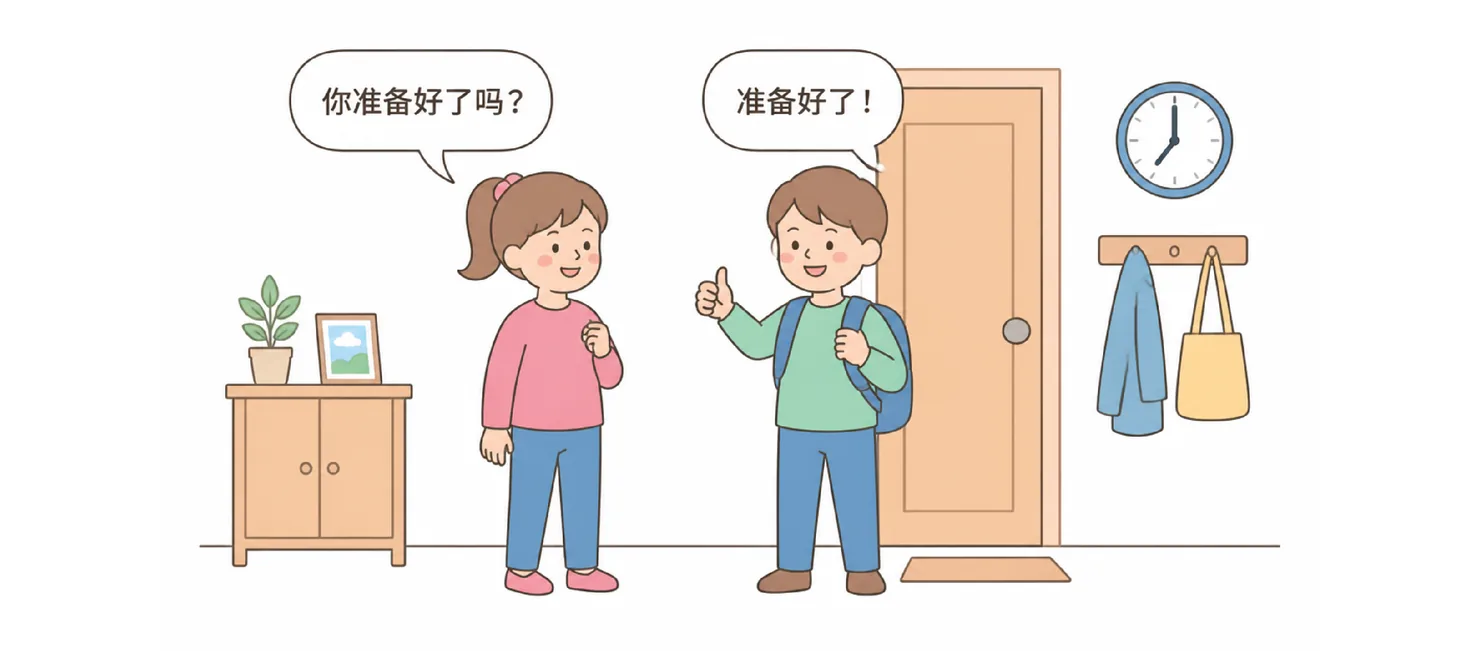 你准备好了吗?— 准备好了!“Are you ready?” — “Ready!”
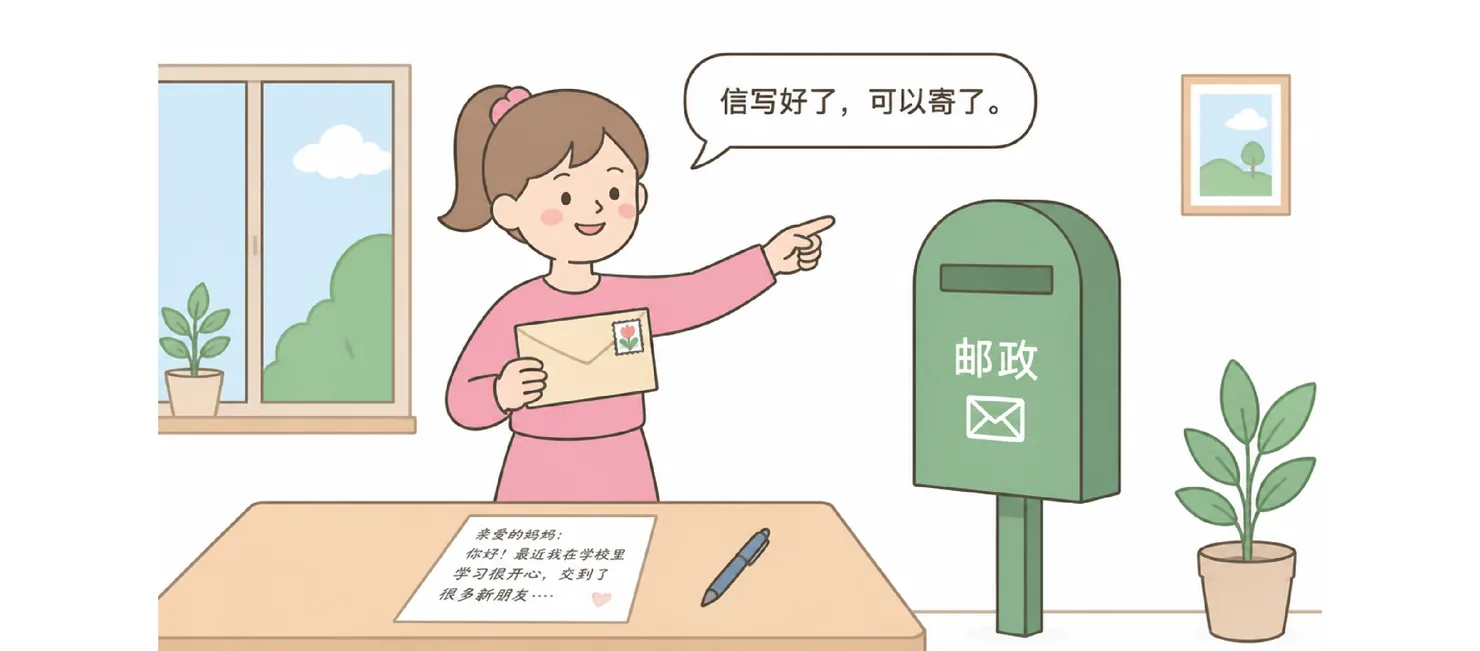 信写好了,可以寄了 — “The letter is written and ready to send.”
Nuance 1 — 好 Means “Ready,” Not “Good”
This is the most important nuance. As a result complement, 好 is not a quality judgment. It states that the action is complete and the result is in a usable, satisfactory state. 准备好了 means "fully prepared," not "prepared nicely."
Result-complement 好 = ready / properly done, never "good" as a judgment.
| 好 as… | Meaning | Chinese | Pinyin | English |
|---|---|---|---|---|
| result complement | ready / properly done | 准备好了 | zhǔnbèi hǎo le | fully prepared / ready |
| adjective | good | 好书 | hǎo shū | a good book |
Nuance 2 — 好 vs. 完: Two Ways to “Finish”
Both 好 and 完 translate as "finish," but they emphasize different things. 完 is about reaching the end (quantity); 好 is about the result being ready and satisfactory (quality/state). This is the most common point of confusion for learners.
完 = you reached the end. 好 = the result is ready and satisfactory.
| Aspect | 好 (hǎo) | 完 (wán) |
|---|---|---|
| Meaning | ready / properly done | finished / completed (quantity) |
| Focus | quality and readiness | quantity and completion |
| Example | 我写好了。 (Wǒ xiě hǎo le. — I’ve written it properly / it’s ready.) | 我写完了。 (Wǒ xiě wán le. — I finished writing.) |
| Question | 你准备好了吗? (Nǐ zhǔnbèi hǎo le ma? — Are you ready?) | 你写完了吗? (Nǐ xiě wán le ma? — Did you finish writing?) |
| Negation | 没准备好 (méi zhǔnbèi hǎo — not ready) | 没写完 (méi xiě wán — didn’t finish) |
Rule of thumb: for the bare fact that homework is done, use 完. For “my homework is ready / done properly,” use 好.
Nuance 3 — Nothing Comes Between the Verb and 好
| Chinese | Pinyin | English | |
|---|---|---|---|
| ✅ Correct | 我准备好了。 | Wǒ zhǔnbèi hǎo le. | I’m ready. |
| ❌ Incorrect | 我准备了好。 | Wǒ zhǔnbèi le hǎo. | 了 cannot separate the verb and 好. |
| Chinese | Pinyin | English | |
|---|---|---|---|
| ✅ Correct | 我们约好了。 | Wǒmen yuē hǎo le. | We’ve made an appointment. |
| ❌ Incorrect | 我们约了好。 | Wǒmen yuē le hǎo. | 了 cannot separate the verb and 好. |
Nuance 4 — 好 Loves 了
Because 好 reports a state of readiness, 了 is very often attached to confirm that the state has now been reached. These three combinations are everyday spoken Chinese.
了 usually follows 好 to confirm the ready state has been reached.
| Phrase | Pinyin | Meaning | When you’d say it |
|---|---|---|---|
| 准备好了 | zhǔnbèi hǎo le | ready | before an event |
| 做好了 | zuò hǎo le | done / ready | after completing a task |
| 写好了 | xiě hǎo le | written / ready | after writing something |
Negation — Use 没, Not 不
| Chinese | Pinyin | English | |
|---|---|---|---|
| ✅ Correct | 我没准备好。 | Wǒ méi zhǔnbèi hǎo. | I’m not ready. |
| ❌ Incorrect | 我不准备好。 | Wǒ bù zhǔnbèi hǎo. | 没 is for completed actions, not 不. |
| Chinese | Pinyin | English | |
|---|---|---|---|
| ✅ Correct | 信还没写好。 | Xìn hái méi xiě hǎo. | The letter isn’t written yet. |
| ❌ Incorrect | 信还不写好。 | Xìn hái bù xiě hǎo. | 没 is for completed actions, not 不. |
The one place 不 appears: the potential form — 做不好 (zuò bu hǎo, cannot do it properly), 准备不好 (zhǔnbèi bu hǎo, cannot get ready), 写不好 (xiě bu hǎo, cannot write it well).
Quick Reference
| Point | Summary |
|---|---|
| Meaning | 好 = successfully done / ready / properly completed |
| Attachment | directly after the verb — nothing in between |
| Object position | after the V+好 pair |
| Negation | 没 for completed actions; 不 only in the potential form |
| 好 vs 完 | 好 = ready, done well · 完 = finished, reached the end |
| Common verbs | 做, 准备, 写, 画, 修, 安排, 想, 约 |
Drills
Fill in the correct result complement. Choose from 好 / 完 / 到. Each question’s English meaning is the hint.
- 饭已经做___了。(The meal is ready.)
- 你准备___了吗?(Are you ready?)
- 我想___了。(I’ve made up my mind.)
- 信写___了,可以寄了。(The letter is ready to send.)
- 我们约___了明天见面。(We’ve arranged to meet tomorrow.)
- 我没准备___。(I’m not ready.)
- 事情都安排___了。(Everything has been properly arranged.)
- 自行车修___了吗?(Has the bike been repaired?)
- 我吃___饭了。(I finished eating.)
- 票都卖___了。(The tickets are all sold out.)
- 你找___钥匙了吗?(Did you find the keys?)
- 这本书我看___了,很有意思。(I finished reading this book.)
Answer Key: 1. 好 2. 好 3. 好 4. 好 5. 好 6. 好 7. 好 8. 好 9. 完 10. 完 11. 到 12. 完
Notes
- Common V+好 chunks worth memorising: 做好, 准备好, 写好, 画好, 修好, 安排好, 想好, 约好.
- 好 needs a verb that can reach a “ready” state — it cannot attach to 喜欢 or 知道.
- 约好 and 说好 extend the idea to agreements: the arrangement is settled, not merely discussed.
- For the whole complement family and how they compare, see result complements.
Sources
HSK Standard Course 3 — L1 (结果补语 “好”) HSK Standard Course 2 — L9 (结果补语, result complements introduced) HSK Standard Course 3 — L6 (V得/不 + RC, potential form)