Mandarin Conjunctions — Complete Guide
Overview
Imagine trying to tell a story without words like "because," "so," "but," or "if." Your sentences would feel choppy and disconnected — "It rained. We didn't go to the park." — but the connection between those ideas stays unclear. Did you not go because it rained? Or was the rain just an unrelated detail? Conjunctions are the glue that joins your ideas and shows the logical relationship between them. In Mandarin Chinese, mastering conjunctions is a key milestone that transforms you from a learner who produces simple, isolated sentences into an intermediate speaker who can express complex thoughts and tell coherent stories.
Conjunctions connect clauses and show the logical relationship between them — cause, result, contrast, or condition. Mastering them is what separates choppy beginner sentences from natural, fluent Mandarin.
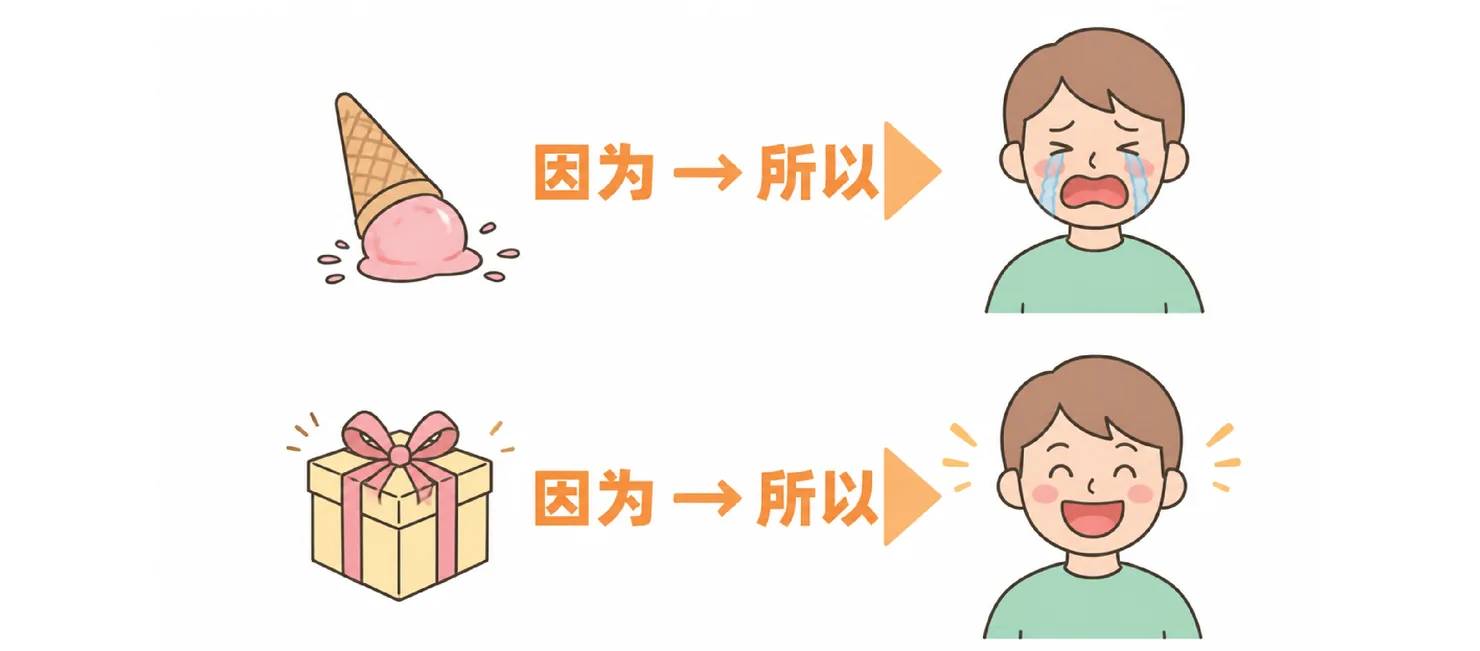 因为 (because) → 所以 (so) — conjunctions show why one event leads to another.
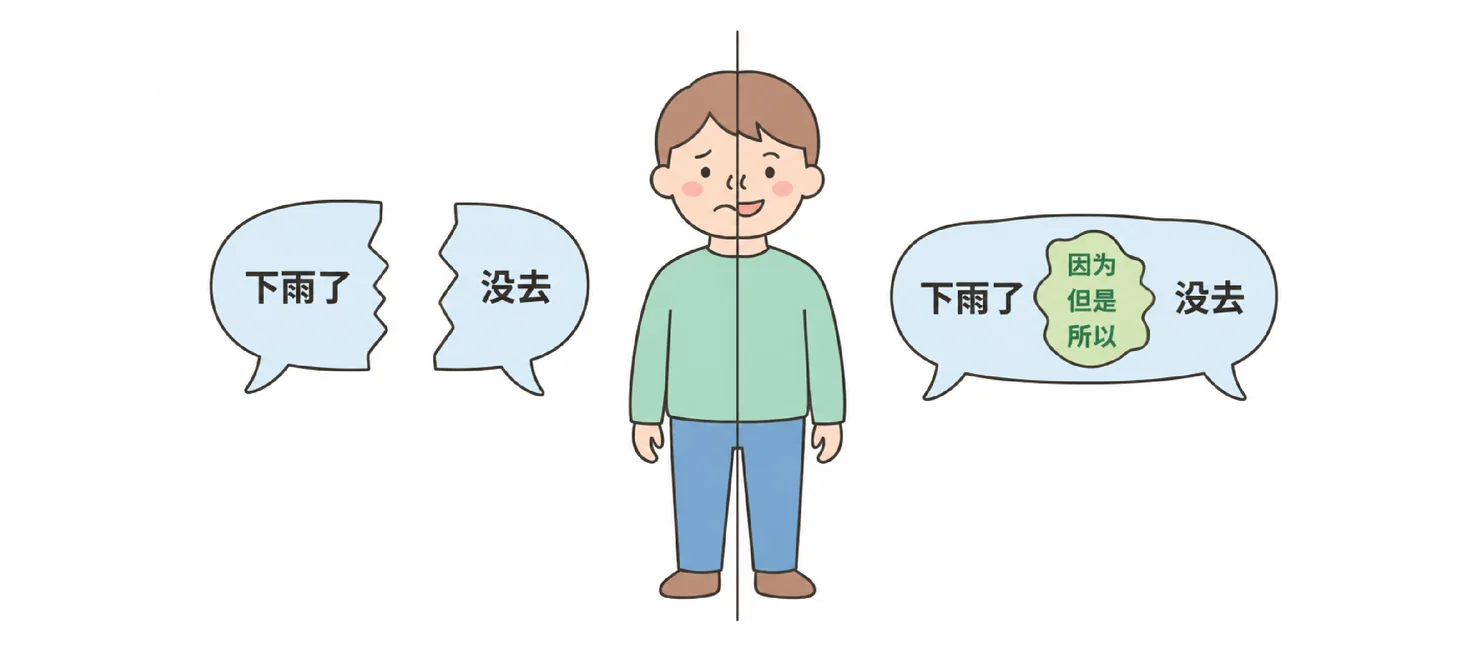 Without conjunctions, the link between 下雨了 and 没去 stays unclear. Conjunctions make the logical relationship explicit.
Use the chart below as a quick bird’s-eye view before diving into each conjunction’s detailed section.
| Conjunction | Pinyin | Meaning | Register | When to Use |
|---|---|---|---|---|
| 因为 | yīnwèi | Because | Neutral | To give a reason or cause |
| 所以 | suǒyǐ | So / Therefore | Neutral | To state a logical result or conclusion |
| 就 | jiù | Then / As a result | Casual | To show a natural, immediate consequence |
| 但是 | dànshì | But / However | Neutral | To introduce contrast (default choice) |
| 但 | dàn | But / However | Formal / Written | To introduce contrast in formal writing |
| 可是 | kěshì | However | Softer, emotional | To soften a refusal or show empathy |
| 不过 | búguò | But / Though | Casual | To downplay a minor contrast |
| 如果 | rúguǒ | If | Neutral | To introduce a condition |
| 要是 | yàoshi | If | Colloquial | To introduce a condition in casual speech |
| 虽然…但是 | suīrán…dànshì | Although…but | Neutral | To express concession (both parts required) |
The Conjunctions
Each section below covers one conjunction or conjunction group in detail — including usage rules, example tables, common pitfalls, and nuance comparisons. Click any section to expand it and read the full content. You can read all sections at once or jump directly to the one you need.
Tap any section below to expand it. Each one covers usage rules, example tables, and common pitfalls for that conjunction.
因为
To explain why something happens, use 因为. It introduces the reason or cause and answers the question "Why?" (为什么 — wèishénme). Place 因为 before the clause that gives the reason — this signals to the listener: "Here comes the explanation."
因为 introduces the reason or cause. It answers "Why?" — place it before the reason clause.
Point 1: Basic Usage
| Chinese | Pinyin | English |
|---|---|---|
| 因为下雨,我们没去。 | Yīnwèi xià yǔ, wǒmen méi qù. | Because it rained, we didn’t go. |
| 因为很累,他早睡了。 | Yīnwèi hěn lèi, tā zǎo shuì le. | Because he was tired, he went to bed early. |
| 因为便宜,我买了。 | Yīnwèi piányi, wǒ mǎi le. | Because it was cheap, I bought it. |
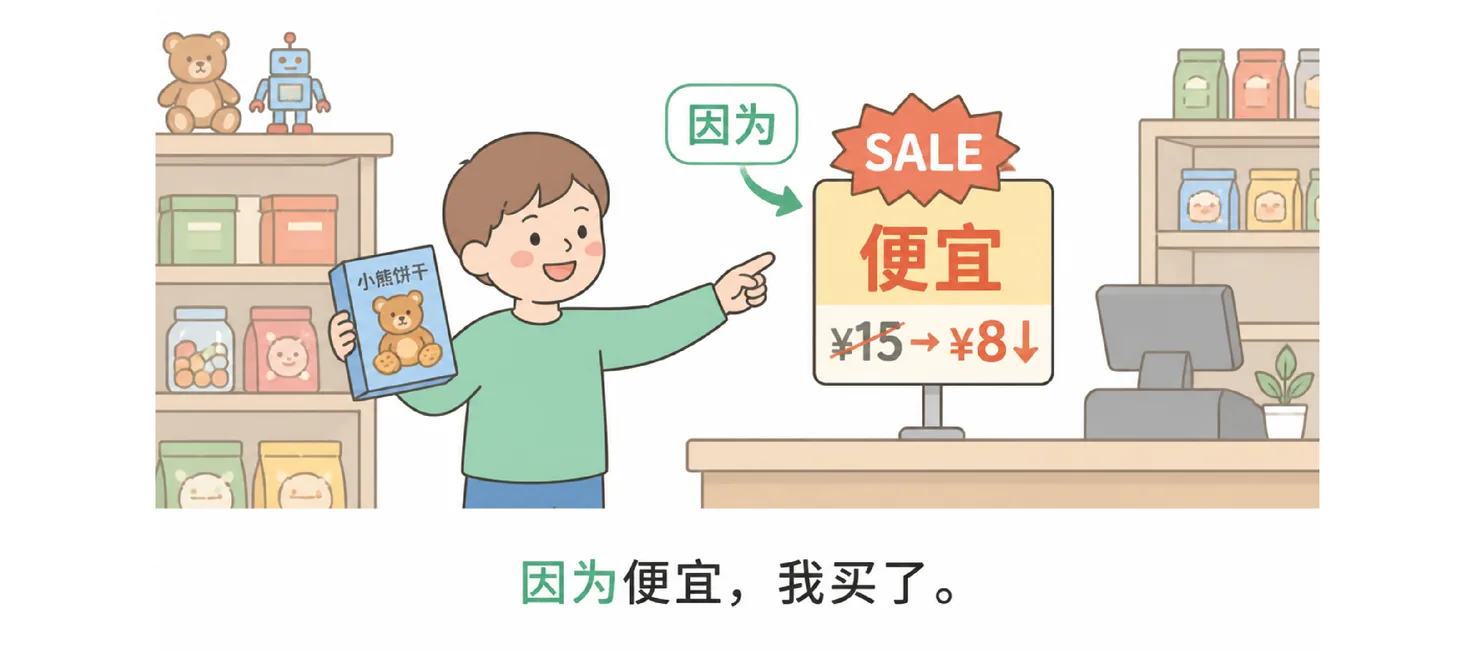 因为便宜,我买了。— Because it was cheap, I bought it.
💡 Position flexibility: 因为 can come at the beginning (emphasising the reason) or after the main clause (emphasising the result). Both are correct: 我没去,因为下雨了。 (I didn’t go, because it rained.)
Point 2: The 因为…所以… Pair
Pair 因为 with 所以 (so / therefore) to form a complete cause-effect structure. While English typically uses only "because" OR "so" in a single sentence, Mandarin commonly uses both together. The 因为 clause sets up the cause, and the 所以 clause delivers the effect.
Pair 因为 with 所以 for a full cause → effect sentence. Both are used in the same sentence — unlike English, which chooses one or the other.
Pattern: 因为 + Reason, 所以 + Result
| Chinese | Pinyin | English |
|---|---|---|
| 因为下雨了,所以我们没去公园。 | Yīnwèi xià yǔ le, suǒyǐ wǒmen méi qù gōngyuán. | Because it rained, we didn’t go to the park. |
| 因为努力学习,所以他考得很好。 | Yīnwèi nǔlì xuéxí, suǒyǐ tā kǎo de hěn hǎo. | Because he studied hard, he did well on the test. |
| 因为天气冷,所以我不出门。 | Yīnwèi tiānqì lěng, suǒyǐ wǒ bù chūmén. | Because the weather is cold, I’m not going out. |
| 因为手机没电了,所以我打不了电话。 | Yīnwèi shǒujī méi diàn le, suǒyǐ wǒ dǎ bù liǎo diànhuà. | Because my phone has no battery, I can’t make calls. |
| 因为作业很多,所以他十一点才睡觉。 | Yīnwèi zuòyè hěn duō, suǒyǐ tā shíyī diǎn cái shuìjiào. | Because there was a lot of homework, he didn’t sleep until 11. |
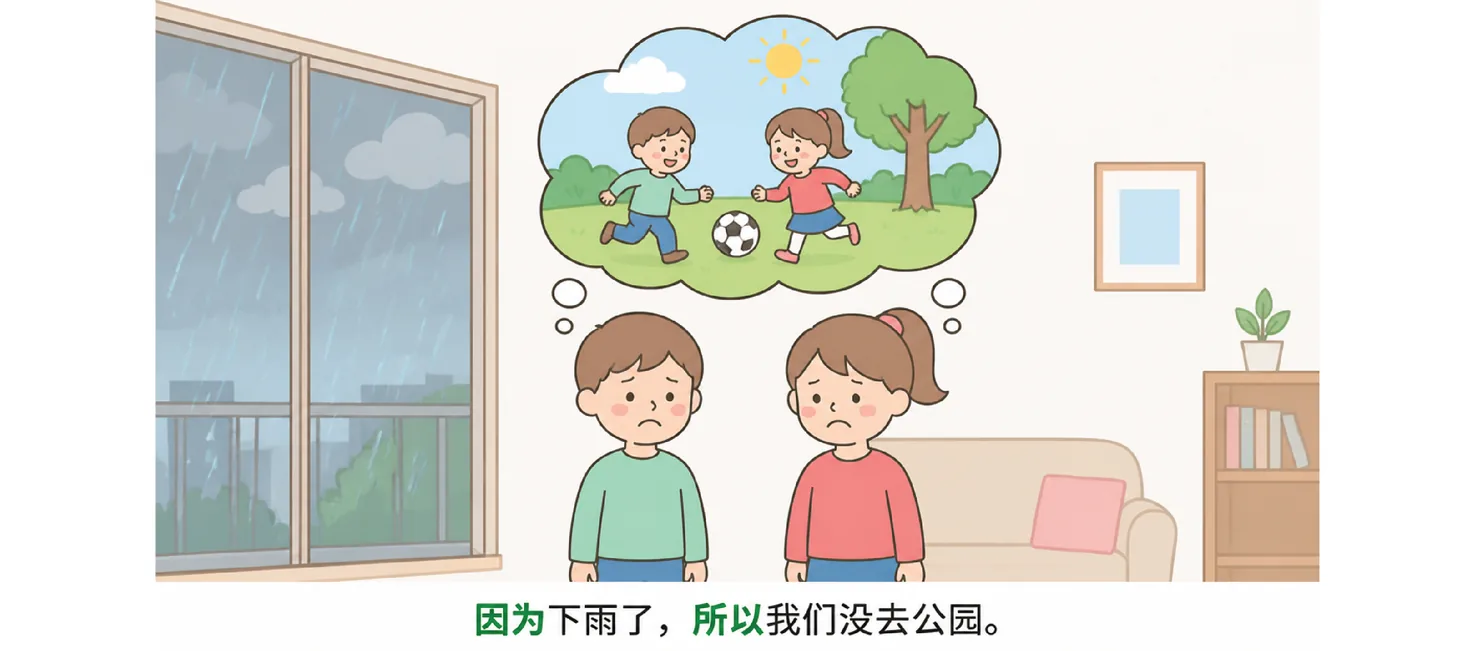 因为下雨了,所以我们没去公园。— Because it rained, we didn’t go to the park.
📝 Using 因为 alone is perfectly fine in casual conversation. The 因为…所以 pair is not required every time.
Point 3: 所以 Cannot Come First
所以 always follows the reason. It cannot start a sentence unless the cause has already been clearly established in the previous sentence.
| Chinese | Pinyin | English | |
|---|---|---|---|
| ✅ Correct | 因为我工作很多,所以我很累。 | Yīnwèi wǒ gōngzuò hěn duō, suǒyǐ wǒ hěn lèi. | Because I have a lot of work, I’m very tired. |
| ❌ Incorrect | 所以我很累,因为我工作很多。 | Suǒyǐ wǒ hěn lèi, yīnwèi wǒ gōngzuò hěn duō. | (Incorrect order — the reason must come first) |
| Chinese | Pinyin | English | |
|---|---|---|---|
| ✅ Correct | 他病了,所以没来。 | Tā bìng le, suǒyǐ méi lái. | He was sick, so he didn’t come. |
| ❌ Incorrect | 所以没来。(no prior context) | Suǒyǐ méi lái. | (Missing the reason — 所以 needs a preceding cause) |
Exception in conversation: If the reason was just stated by another speaker, 所以 can stand alone. A: 我今天很累。B: 所以早点睡吧。(A: I’m very tired today. B: So go to bed early.) The cause was already established, so 所以 alone is natural.
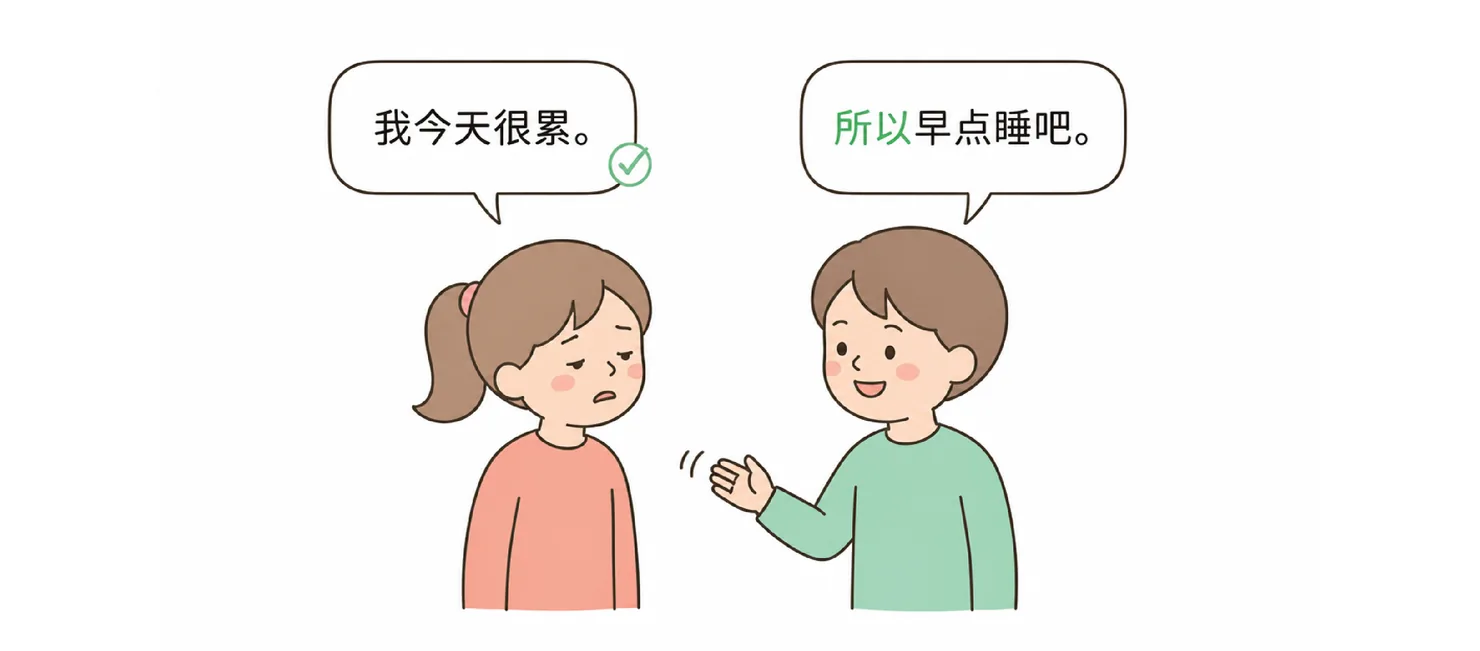 A: 我今天很累。B: 所以早点睡吧。— When the cause is already established in context, 所以 can stand alone in reply.
所以
Use 所以 to state a result, conclusion, or consequence. It always appears after the reason and signals to the listener that what follows is the logical outcome of what was just stated. Place 所以 after the reason clause to introduce the result.
所以 introduces the result or conclusion. It always follows a reason — it cannot start a sentence on its own.
Point 1: Basic Usage
| Chinese | Pinyin | English |
|---|---|---|
| 他很忙,所以没来开会。 | Tā hěn máng, suǒyǐ méi lái kāihuì. | He was busy, so he didn’t come to the meeting. |
| 下雨了,所以比赛取消了。 | Xià yǔ le, suǒyǐ bǐsài qǔxiāo le. | It rained, so the match was cancelled. |
| 手机没电了,所以打不了电话。 | Shǒujī méi diàn le, suǒyǐ dǎ bù liǎo diànhuà. | The phone has no battery, so I can’t make calls. |
| 她哭了,所以眼睛红了。 | Tā kū le, suǒyǐ yǎnjīng hóng le. | She cried, so her eyes are red. |
| 他病了,所以今天没来学校。 | Tā bìng le, suǒyǐ jīntiān méi lái xuéxiào. | He was sick, so he didn’t come to school today. |
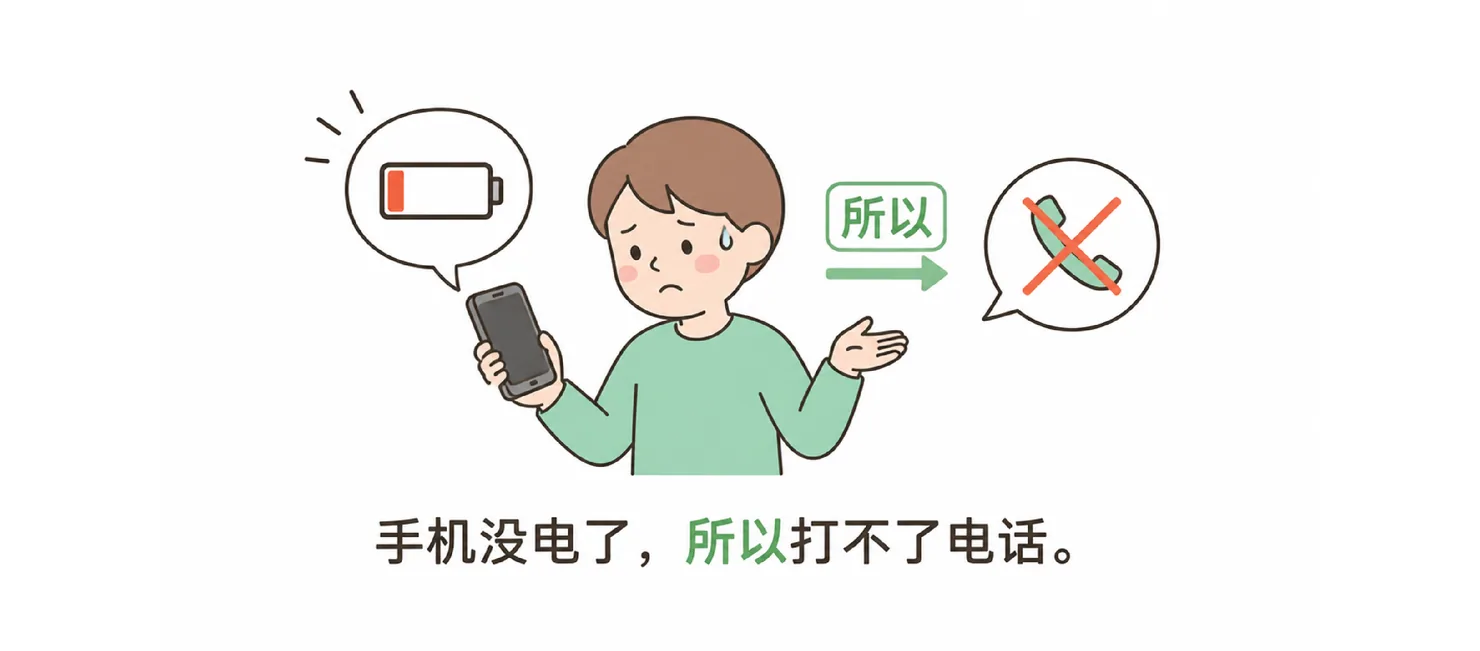 手机没电了,所以打不了电话。— The phone has no battery, so I can’t make calls.
Point 2: 所以 Must Follow a Reason
所以 cannot stand alone. It requires a cause — either in the same sentence or clearly established in the previous sentence.
| Chinese | Pinyin | English | |
|---|---|---|---|
| ✅ Correct | 他病了,所以没来。 | Tā bìng le, suǒyǐ méi lái. | He was sick, so he didn’t come. |
| ❌ Incorrect | 所以没来。(no prior context) | Suǒyǐ méi lái. | (Missing reason — 所以 needs a preceding cause) |
| Chinese | Pinyin | English | |
|---|---|---|---|
| ✅ Correct | 因为累了,所以睡了。 | Yīnwèi lèi le, suǒyǐ shuì le. | Because I was tired, I slept. |
| ❌ Incorrect | 所以睡了。(no prior context) | Suǒyǐ shuì le. | (Listener will ask: “所以… because of what?”) |
就
Use 就 to show that one action naturally or immediately follows another. It is more casual than 所以 and frequently appears in everyday conversation. The nuance of 就 is that the result is expected or obvious given the preceding situation. Place 就 before the verb that describes the natural consequence.
就 (jiù) shows an immediate, natural consequence — "then." More casual than 所以. Goes before the verb in the result clause.
Point 1: Basic Usage
| Chinese | Pinyin | English |
|---|---|---|
| 你努力,就会成功。 | Nǐ nǔlì, jiù huì chénggōng. | If you work hard, (then) you will succeed. |
| 他来了,我们就开始。 | Tā lái le, wǒmen jiù kāishǐ. | He’s coming, (then) we’ll start. |
| 天黑了,就回家吧。 | Tiān hēi le, jiù huí jiā ba. | It’s getting dark, (so) let’s go home. |
| 吃完饭,就写作业。 | Chī wán fàn, jiù xiě zuòyè. | After eating, (then) do homework. |
| 下课后,就去图书馆。 | Xià kè hòu, jiù qù túshūguǎn. | After class, (then) go to the library. |
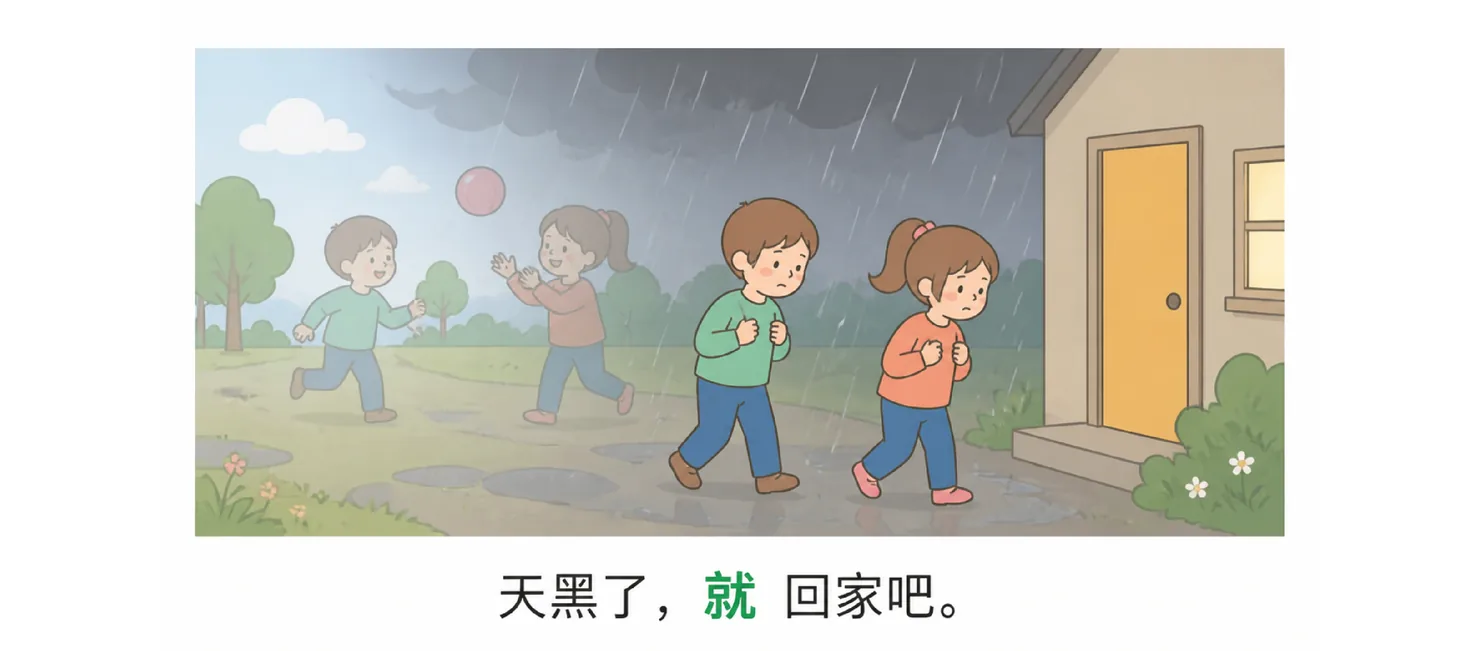 天黑了,就回家吧。— It’s getting dark, so let’s head home.
Point 2: 就 in Conditional Sentences with 如果
Pair 就 with 如果 (if) to express “if…then…” relationships. This pattern is extremely common in everyday Mandarin.
Pattern: 如果 + Condition, 就 + Result
| Chinese | Pinyin | English |
|---|---|---|
| 如果你来,我就高兴。 | Rúguǒ nǐ lái, wǒ jiù gāoxìng. | If you come, I’ll be happy. |
| 如果下雨,我就不去。 | Rúguǒ xià yǔ, wǒ jiù bù qù. | If it rains, I won’t go. |
| 如果饿了,就吃饭。 | Rúguǒ è le, jiù chīfàn. | If you’re hungry, then eat. |
| 如果不会,就问老师。 | Rúguǒ bú huì, jiù wèn lǎoshī. | If you don’t know, ask the teacher. |
| 如果明天不下雨,我们就去爬山。 | Rúguǒ míngtiān bù xià yǔ, wǒmen jiù qù páshān. | If it doesn’t rain tomorrow, we’ll go hiking. |
Point 3: 就 vs. 所以 — Choosing the Right One
Both 就 and 所以 express results, but they serve different functions.
| Aspect | 所以 (suǒyǐ) | 就 (jiù) |
|---|---|---|
| Formality | More formal; suitable for writing | More casual; common in conversation |
| Meaning | ”Therefore” — a logical conclusion | ”Then” — a natural, immediate consequence |
| Focus | Emphasises logical reasoning | Emphasises immediacy and natural flow |
| Chinese | Pinyin | English | |
|---|---|---|---|
| ✅ Correct | 你努力,就会成功。 | Nǐ nǔlì, jiù huì chénggōng. | Work hard, and you’ll succeed. |
| ❌ Incorrect | 你努力,所以会成功。 | Nǐ nǔlì, suǒyǐ huì chénggōng. | (所以 sounds too formal here — 就 is natural for an expected consequence) |
| Chinese | Pinyin | English | |
|---|---|---|---|
| ✅ Correct | 他很努力,所以成功了。 | Tā hěn nǔlì, suǒyǐ chénggōng le. | He worked hard, so he succeeded. |
| ❌ Incorrect | 他很努力,就成功了。 | Tā hěn nǔlì, jiù chénggōng le. | (就 sounds too casual — 所以 is better for a reasoned logical conclusion) |
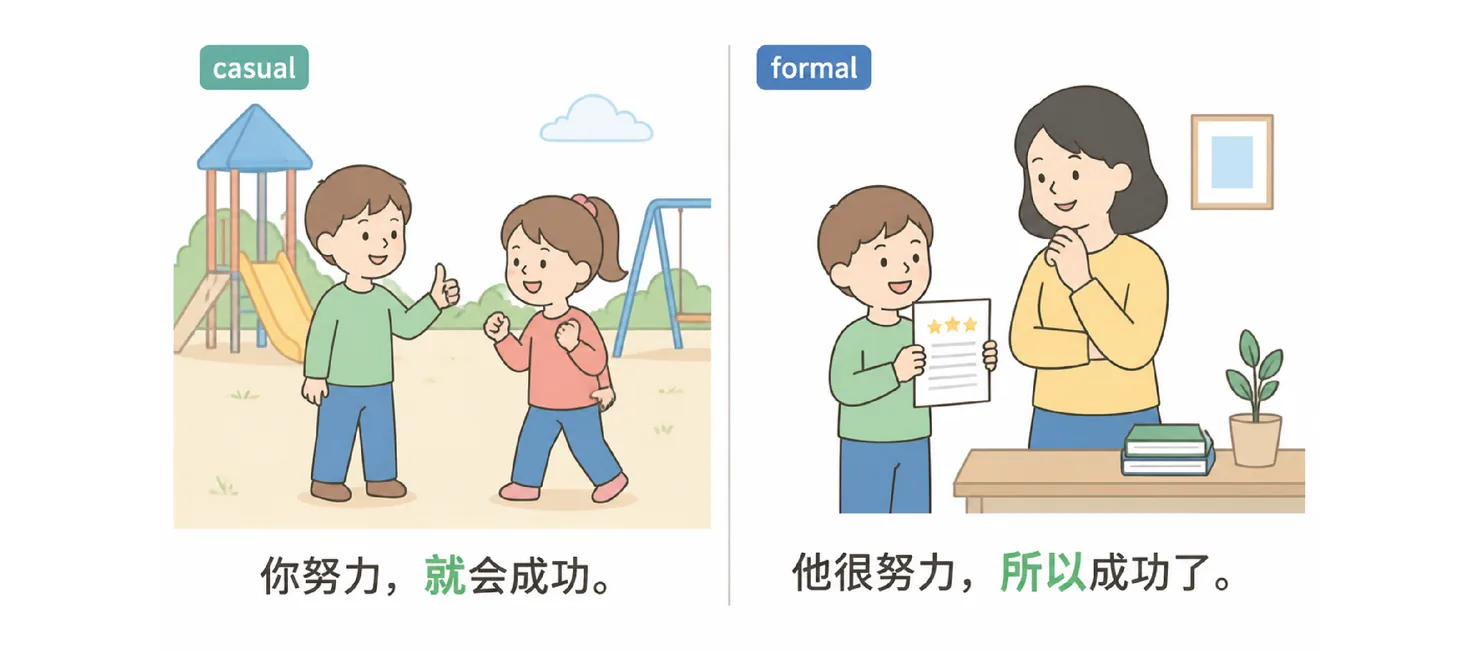 就 suits casual, immediate consequences. 所以 suits formal, reasoned conclusions.
但 / 但是
Use 但 and 但是 to introduce a contrast, exception, or unexpected turn. The first clause sets up an expectation, and the second clause contradicts or limits that expectation. These conjunctions sit at the junction between two opposing ideas. Place 但 or 但是 between the two contrasting clauses.
但是 (the default) or 但 (more formal/written) — introduce contrast. The second clause contradicts or limits the first.
Point 1: Basic Usage
| Chinese | Pinyin | English |
|---|---|---|
| 我想去,但是我没时间。 | Wǒ xiǎng qù, dànshì wǒ méi shíjiān. | I want to go, but I don’t have time. |
| 这本书很有趣,但是有点贵。 | Zhè běn shū hěn yǒuqù, dànshì yǒudiǎn guì. | This book is interesting, but a bit expensive. |
| 天气冷,但是很晴朗。 | Tiānqì lěng, dànshì hěn qínglǎng. | The weather is cold, but it’s very clear. |
| 他想去公园,但是下雨了。 | Tā xiǎng qù gōngyuán, dànshì xià yǔ le. | He wanted to go to the park, but it rained. |
| 她学习很努力,但是考试没通过。 | Tā xuéxí hěn nǔlì, dànshì kǎoshì méi tōngguò. | She studied very hard, but she didn’t pass the exam. |
 这本书很有趣,但是有点贵。— This book is interesting, but a bit pricey.
Point 2: 但 vs. 但是 — Formality
Both words mean the same thing but suit different contexts.
| Word | Pinyin | Usage |
|---|---|---|
| 但是 | dànshì | Full form. Neutral. Most common in both speech and writing. |
| 但 | dàn | Shortened form. More common in formal writing. Can sound abrupt in casual speech. |
| Chinese | Pinyin | English | |
|---|---|---|---|
| ✅ Correct (formal/written) | 他很有才华,但缺少经验。 | Tā hěn yǒu cáihuá, dàn quēshǎo jīngyàn. | He is very talented, but lacks experience. |
| ✅ Correct (casual/spoken) | 我想吃火锅,但是最近上火。 | Wǒ xiǎng chī huǒguō, dànshì zuìjìn shàng huǒ. | I want to eat hotpot, but I’ve been having too much heat lately. |
| ❌ Incorrect (casual) | 我想吃火锅,但最近上火。 | Wǒ xiǎng chī huǒguō, dàn zuìjìn shàng huǒ. | (但 in casual speech sounds abrupt — use 但是 instead) |
💡 Practical tip: When in doubt, use 但是. It is always appropriate in both speech and writing.
Point 3: Critical Mistake — Don’t Confuse 但是 with 因为
但是 shows contrast — two ideas that oppose each other. 因为 shows cause — one idea explains the other.
💡 Self-check: Ask yourself: “Does the second idea explain the first, or does it contradict it?” If it contradicts, use 但是.
| Chinese | Pinyin | English | |
|---|---|---|---|
| ✅ Correct | 我想吃火锅,但是最近上火。 | Wǒ xiǎng chī huǒguō, dànshì zuìjìn shàng huǒ. | I want to eat hotpot, but I’ve been having too much heat. |
| ❌ Incorrect | 我想吃火锅,因为最近上火。 | Wǒ xiǎng chī huǒguō, yīnwèi zuìjìn shàng huǒ. | (因为 is wrong — “having too much heat” doesn’t explain wanting hotpot; it contrasts with it) |
| Chinese | Pinyin | English | |
|---|---|---|---|
| ✅ Correct | 他很聪明,但是不努力。 | Tā hěn cōngmíng, dànshì bù nǔlì. | He’s very smart, but he doesn’t work hard. |
| ❌ Incorrect | 他很聪明,因为不努力。 | Tā hěn cōngmíng, yīnwèi bù nǔlì. | (因为 is wrong — “doesn’t work hard” contrasts with being smart; it doesn’t explain it) |
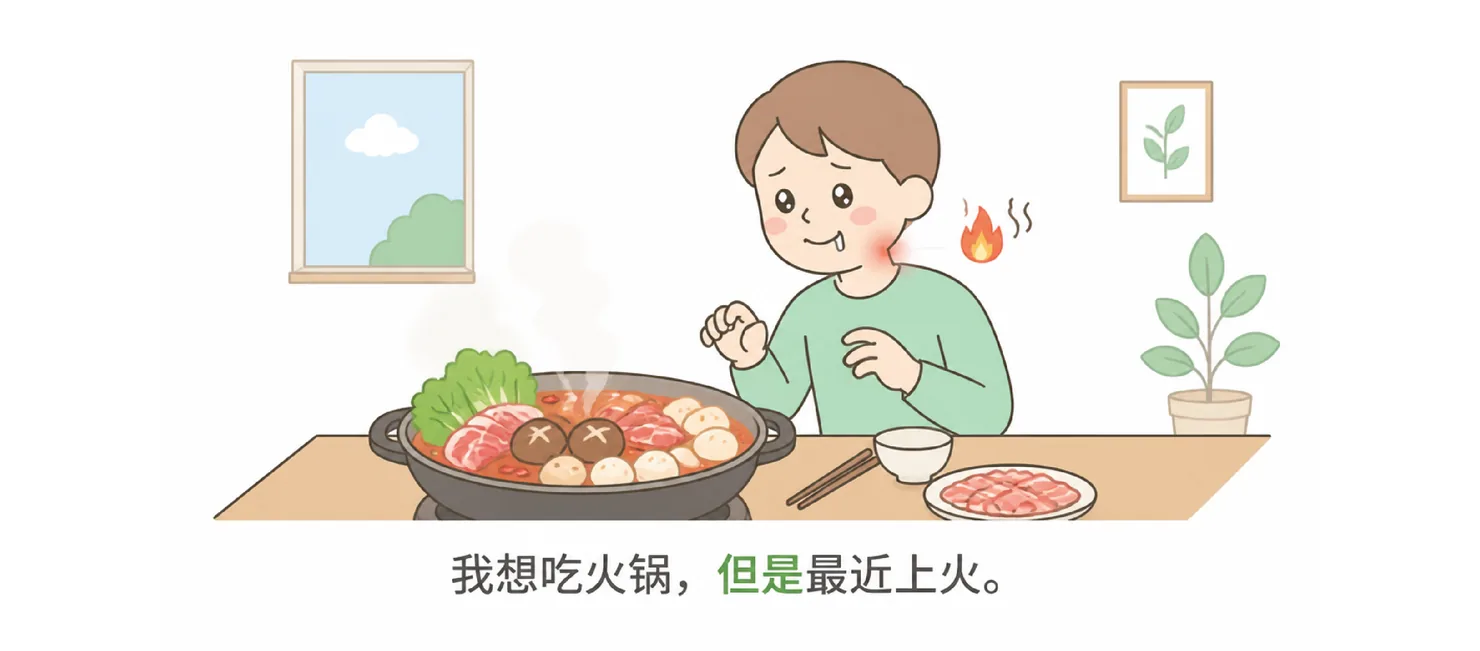 我想吃火锅,但是最近上火。— I want hotpot, but I’ve been having too much internal heat lately.
Point 4: Similar Words — 可是 and 不过
Mandarin offers other ways to say “but” with different tones.
| Word | Pinyin | Meaning | Tone | When to Use |
|---|---|---|---|---|
| 但是 | dànshì | But / However | Neutral | Most situations. Default choice. |
| 可是 | kěshì | However | Softer, emotional | To soften a refusal or show empathy. |
| 不过 | búguò | But / Though | Casual | When the contrast is minor or you want to downplay it. |
| Chinese | Pinyin | English | Nuance |
|---|---|---|---|
| 我很想帮你,可是我没时间。 | Wǒ hěn xiǎng bāng nǐ, kěshì wǒ méi shíjiān. | I really want to help you, but I don’t have time. | 可是 shows empathy. |
| 我很想帮你,但是我没时间。 | Wǒ hěn xiǎng bāng nǐ, dànshì wǒ méi shíjiān. | I want to help you, but I don’t have time. | Neutral. Less emotional than 可是. |
| 这个餐厅不错,不过有点贵。 | Zhège cāntīng bùcuò, búguò yǒudiǎn guì. | This restaurant is good, though a bit pricey. | 不过 downplays the negative. |
| 这个电影还行,不过有点长。 | Zhège diànyǐng hái xíng, búguò yǒudiǎn cháng. | This movie is okay, though a bit long. | 不过 softens the criticism. |
 可是 adds an empathetic, softer tone. 不过 downplays the contrast, keeping the criticism mild.
如果 / 要是
Use 如果 to introduce a condition. Pair it with 就 to form "if…then…" structures. The condition clause describes the situation that must happen for the result to occur. Place 如果 before the condition clause; the result clause follows, often introduced by 就. This signals to the listener that what follows is conditional.
如果 introduces a condition. Pair it with 就 to form "if…then…" sentences. 要是 is the colloquial alternative.
Point 1: Basic Usage
Pattern: 如果 + Condition, 就 + Result
| Chinese | Pinyin | English |
|---|---|---|
| 如果你来,我就做饭。 | Rúguǒ nǐ lái, wǒ jiù zuò fàn. | If you come, (then) I’ll cook. |
| 如果明天下雨,我们就不去。 | Rúguǒ míngtiān xià yǔ, wǒmen jiù bù qù. | If it rains tomorrow, we won’t go. |
| 如果累了,就休息一下。 | Rúguǒ lèi le, jiù xiūxi yíxià. | If you’re tired, take a rest. |
| 如果不知道,就问老师。 | Rúguǒ bù zhīdào, jiù wèn lǎoshī. | If you don’t know, ask the teacher. |
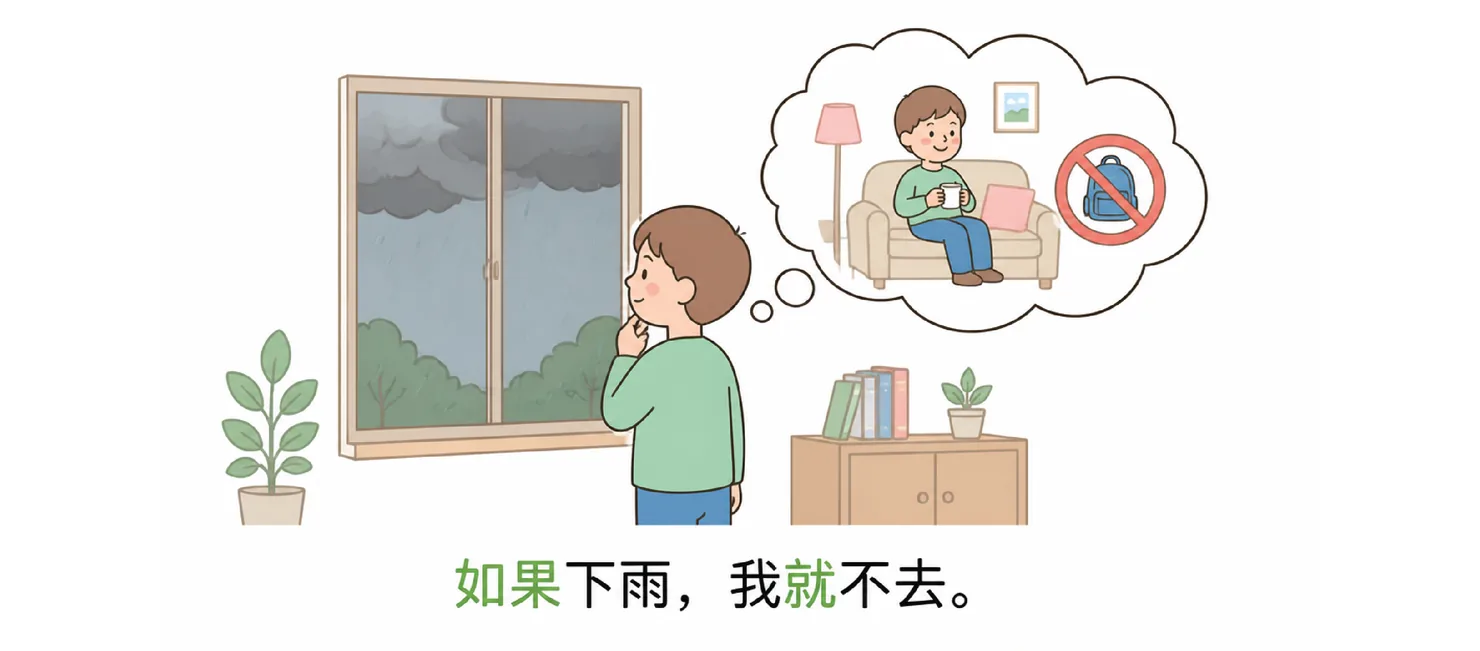 如果下雨,我就不去。— If it rains, I won’t go.
Point 2: More 如果…就 Examples
| Chinese | Pinyin | English |
|---|---|---|
| 如果有时间,我就去看你。 | Rúguǒ yǒu shíjiān, wǒ jiù qù kàn nǐ. | If I have time, I’ll go see you. |
| 如果不会,就问老师。 | Rúguǒ bú huì, jiù wèn lǎoshī. | If you don’t know, ask the teacher. |
| 如果写完作业,就可以看电视。 | Rúguǒ xiě wán zuòyè, jiù kěyǐ kàn diànshì. | If you finish your homework, you can watch TV. |
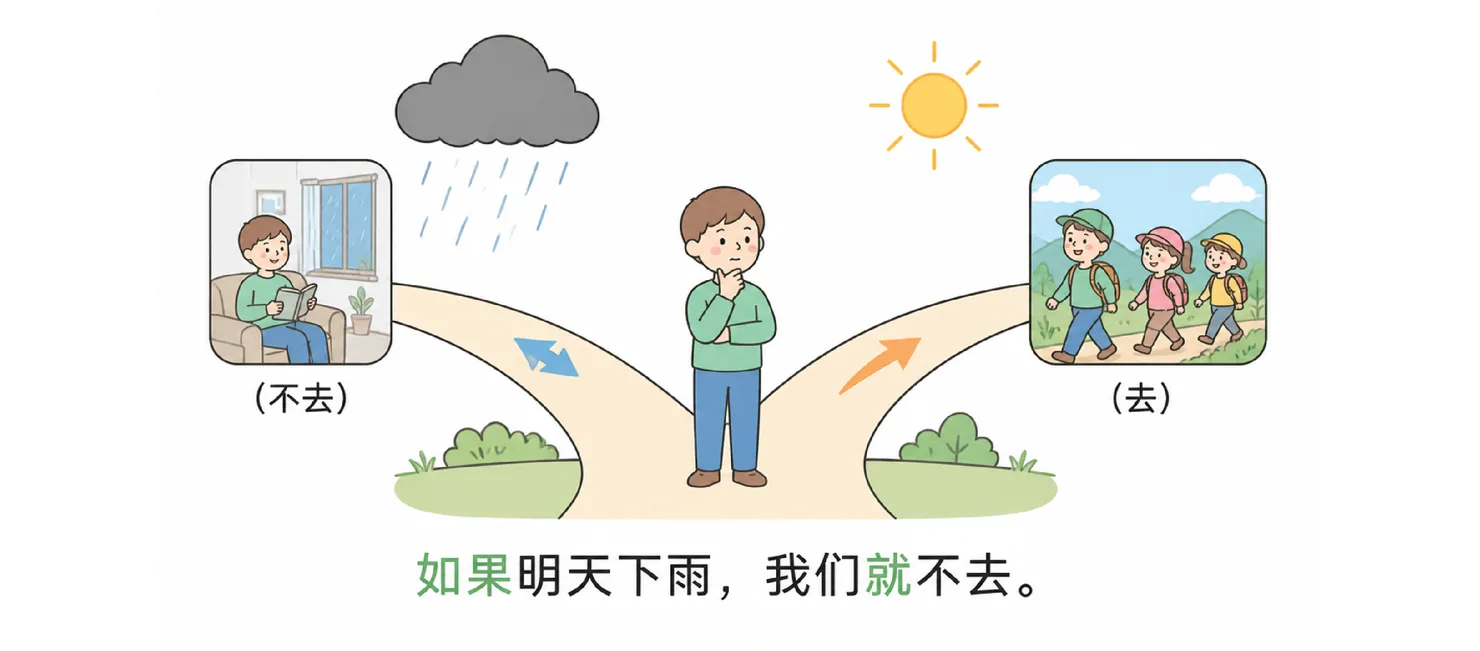 如果明天下雨,我们就不去。— If it rains tomorrow, we won’t go. The condition creates two possible paths.
Point 3: 要是 — Colloquial Alternative
要是 has the same meaning as 如果 but is more colloquial, common in casual conversation.
| Word | Pinyin | Meaning | Register |
|---|---|---|---|
| 如果 | rúguǒ | If | Neutral — suitable for speech and writing |
| 要是 | yàoshi | If | Colloquial — more common in casual speech |
| Chinese | Pinyin | English | Nuance |
|---|---|---|---|
| 要是你来了,就好了。 | Yàoshi nǐ lái le, jiù hǎo le. | If you had come, it would have been great. | Colloquial, everyday speech. |
| 如果明天可以,我们去。 | Rúguǒ míngtiān kěyǐ, wǒmen qù. | If we can tomorrow, we’ll go. | Slightly more formal. |
| 要是下雨的话,我们就不去了。 | Yàoshi xià yǔ dehuà, wǒmen jiù bù qù le. | If it rains, we won’t go. | Very natural in conversation. |
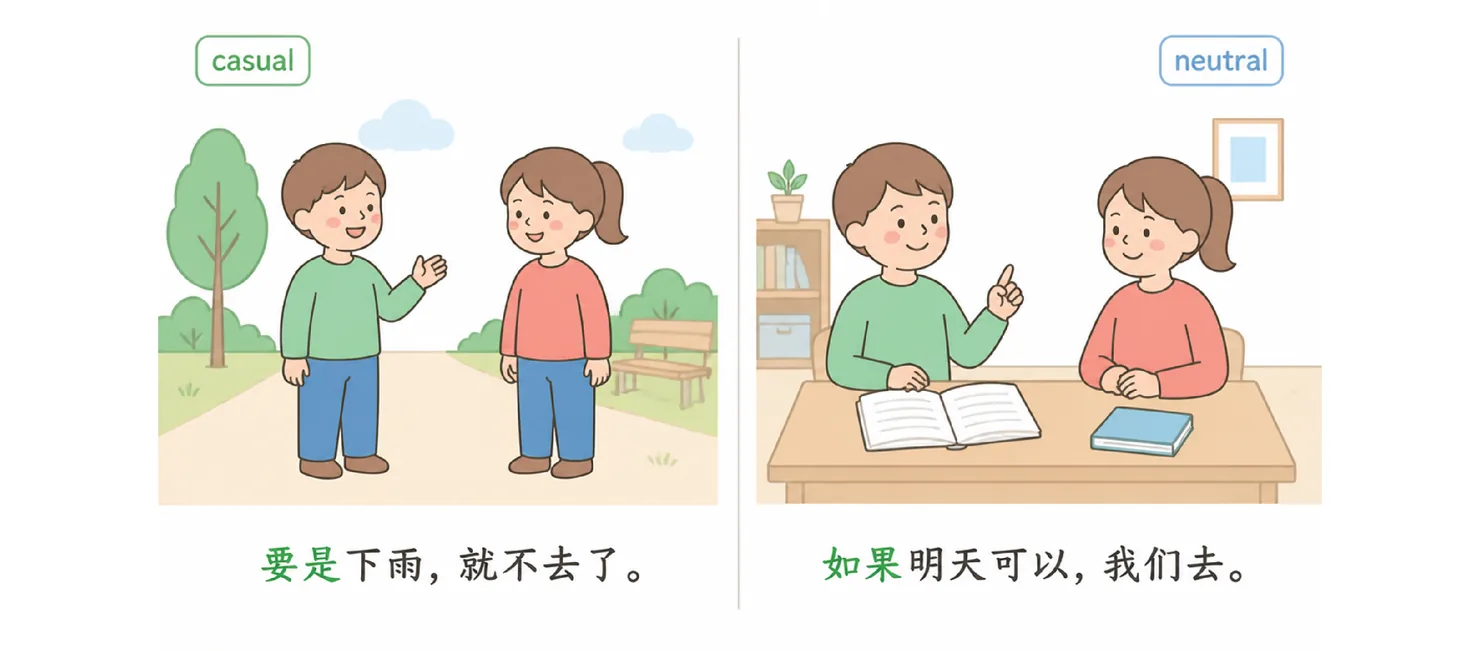 要是 feels casual and conversational. 如果 works comfortably in both casual and formal contexts.
📝 Note about 的话 (dehuà): You’ll often see 如果 or 要是 followed by 的话 in casual speech — it makes the condition feel more conversational. Example: 如果你来的话,我们就去。(If you come, we’ll go.)
虽然…但是
Use 虽然…但是 to express concession — you acknowledge one fact while simultaneously emphasising a contrasting fact. In Mandarin, you must use both parts together, unlike English which uses only one ("although" OR "but"). 虽然 means "although" and sets up the concession; 但是 means "but" and introduces the contrasting result. Together, they signal: "I acknowledge this first point — but despite that, here's the second point."
虽然…但是 = "although…but." Both parts are required in Mandarin — you cannot use 虽然 alone without 但是 to complete the pair.
Point 1: Basic Usage
| Chinese | Pinyin | English |
|---|---|---|
| 虽然难,但是有用。 | Suīrán nán, dànshì yǒu yòng. | Although it’s difficult, it’s useful. |
| 虽然贵,但是质量很好。 | Suīrán guì, dànshì zhìliàng hěn hǎo. | Although it’s expensive, the quality is good. |
| 虽然下雨了,但是比赛继续了。 | Suīrán xià yǔ le, dànshì bǐsài jìxù le. | Although it rained, the match continued. |
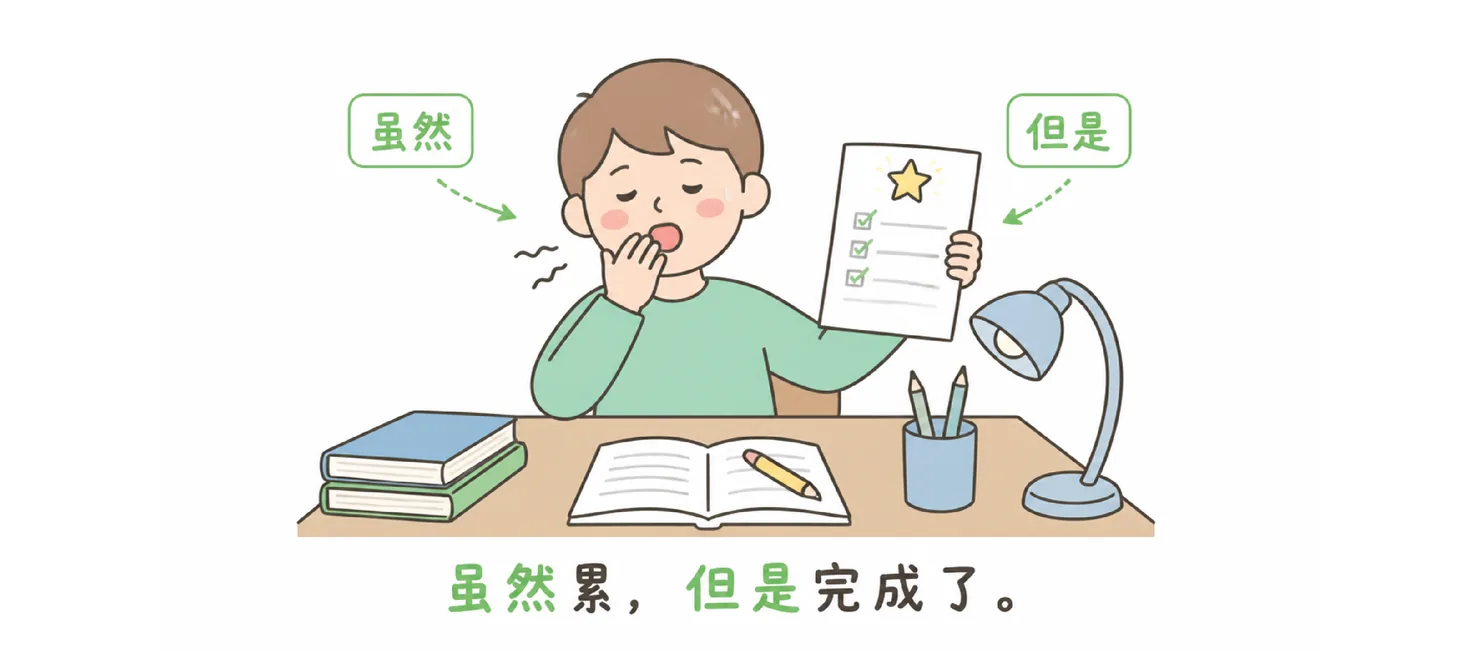 虽然累,但是完成了。— Although tired, the work was finished.
Point 2: Both Parts Are Required
Using 虽然 without 但是 is grammatically incomplete in Mandarin.
| Chinese | Pinyin | English | |
|---|---|---|---|
| ✅ Correct | 虽然难,但是有用。 | Suīrán nán, dànshì yǒu yòng. | Although it’s difficult, it’s useful. |
| ❌ Incorrect | 虽然难,有用。 | Suīrán nán, yǒu yòng. | (Missing 但是 — the pair must be complete) |
| Chinese | Pinyin | English | |
|---|---|---|---|
| ✅ Correct | 虽然贵,但是值得。 | Suīrán guì, dànshì zhíde. | Although it’s expensive, it’s worth it. |
| ❌ Incorrect | 虽然贵,值得。 | Suīrán guì, zhíde. | (Missing 但是 — the pair must be complete) |
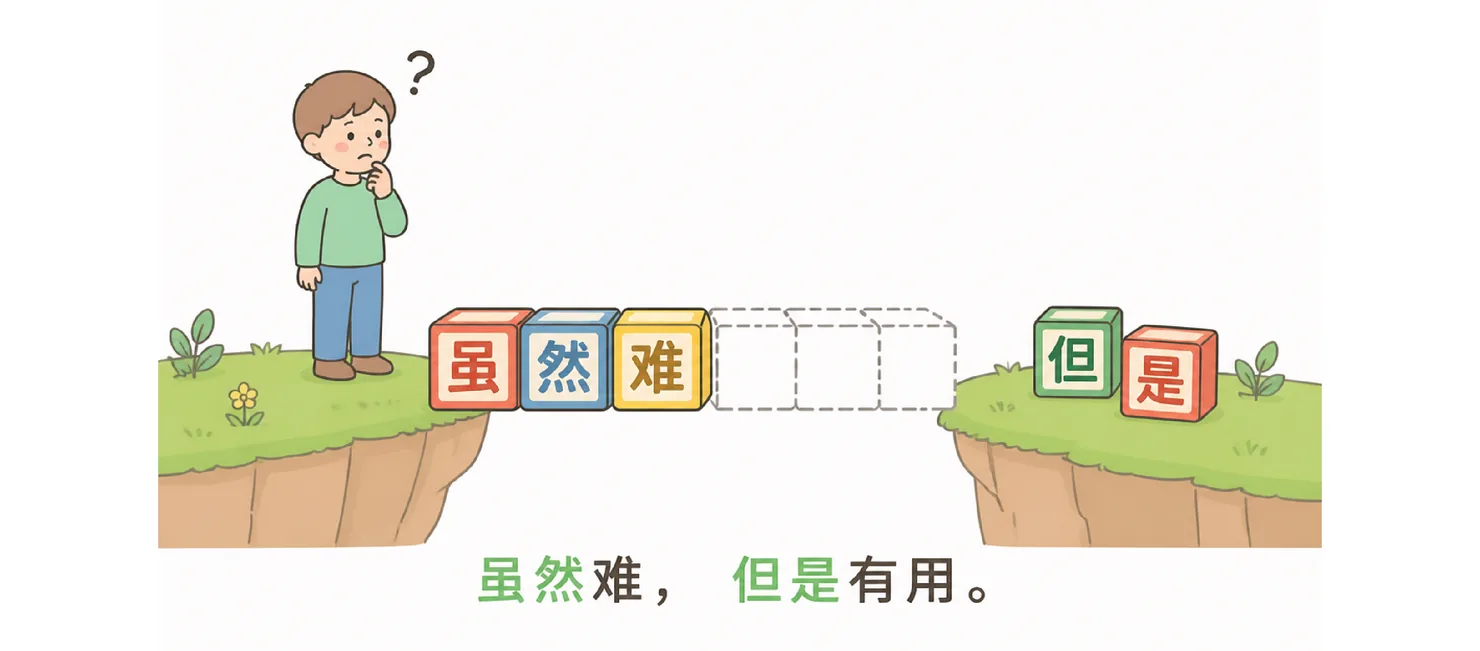 虽然…但是: both parts form a bridge — removing either one leaves the structure incomplete.
📝 You can also use 可是 instead of 但是: 虽然贵,可是质量很好。This gives a slightly softer tone.
Point 3: 虽然…但是 vs. 但是 Alone
| Structure | When to Use |
|---|---|
| 但是 alone | Simple contrast. “He studied, but he didn’t pass.” |
| 虽然…但是 | Concession. “Even though he studied, he didn’t pass.” Stronger contrast — the result is more unexpected. |
| Chinese | Pinyin | English |
|---|---|---|
| 他努力了,但是没成功。 | Tā nǔlì le, dànshì méi chénggōng. | He tried, but didn’t succeed. |
| 虽然努力了,但是没成功。 | Suīrán nǔlì le, dànshì méi chénggōng. | Although he tried, he didn’t succeed. (stronger contrast) |
| 这家店的东西贵,但是质量好。 | Zhè jiā diàn de dōngxi guì, dànshì zhìliàng hǎo. | Things at this store are expensive, but the quality is good. |
| 虽然这家店的东西贵,但是质量好。 | Suīrán zhè jiā diàn de dōngxi guì, dànshì zhìliàng hǎo. | Although things here are expensive, the quality is good. (acknowledges the cost more strongly) |
Point 4: Confusing 虽然…但是 with 因为…所以
虽然…但是 shows concession (contrast despite one fact). 因为…所以 shows cause and effect (one fact explains another). These serve entirely different logical functions.
| Chinese | Pinyin | English | |
|---|---|---|---|
| ✅ Correct | 虽然很累,但是完成了工作。 | Suīrán hěn lèi, dànshì wánchéng le gōngzuò. | Although he was tired, he finished the work. |
| ❌ Incorrect | 因为很累,所以完成了工作。 | Yīnwèi hěn lèi, suǒyǐ wánchéng le gōngzuò. | (Wrong — being tired doesn’t explain finishing the work; it contrasts with it) |
| Chinese | Pinyin | English | |
|---|---|---|---|
| ✅ Correct | 虽然身体不好,但是很努力。 | Suīrán shēntǐ bù hǎo, dànshì hěn nǔlì. | Although his health is not good, he works very hard. |
| ❌ Incorrect | 因为身体不好,所以很努力。 | Yīnwèi shēntǐ bù hǎo, suǒyǐ hěn nǔlì. | (Wrong — poor health doesn’t explain working hard; it contrasts with what you’d expect) |
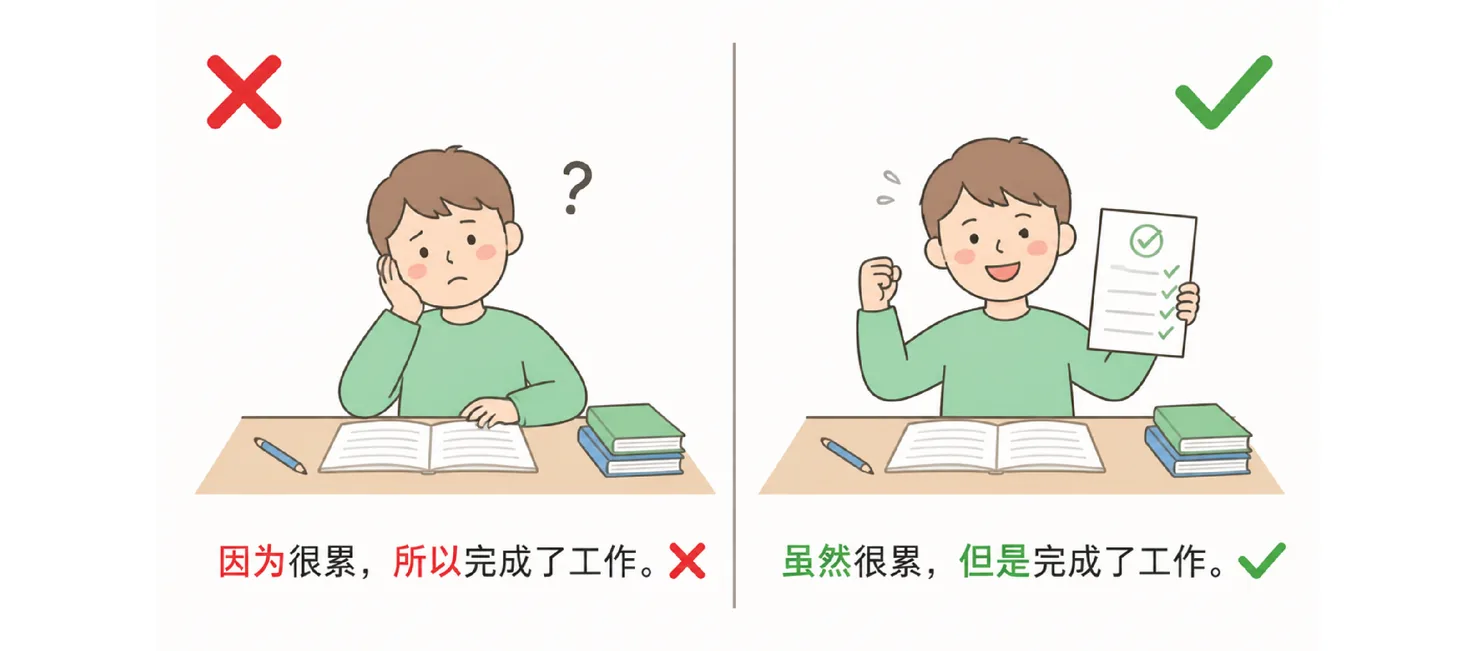 虽然…但是 = concession (despite being tired). 因为…所以 = cause-effect (because of tiredness). They are not interchangeable.
Quick Reference
| Conjunction | HSK | Pinyin | Meaning | Example Chinese | Example Pinyin |
|---|---|---|---|---|---|
| 因为 | 1 | yīnwèi | Because | 因为下雨,我们没去。 | Yīnwèi xià yǔ, wǒmen méi qù. |
| 所以 | 1 | suǒyǐ | So / Therefore | 他病了,所以没来。 | Tā bìng le, suǒyǐ méi lái. |
| 就 | 2 | jiù | Then / As a result | 你努力,就会成功。 | Nǐ nǔlì, jiù huì chénggōng. |
| 但是 | 2 | dànshì | But / However | 我想去,但是没钱。 | Wǒ xiǎng qù, dànshì méi qián. |
| 但 | 2 | dàn | But (formal) | 他聪明,但太年轻。 | Tā cōngmíng, dàn tài niánqīng. |
| 可是 | 2 | kěshì | However (softer) | 我想去,可是没时间。 | Wǒ xiǎng qù, kěshì méi shíjiān. |
| 不过 | 3 | búguò | But / Though (casual) | 这个不错,不过有点贵。 | Zhège bùcuò, búguò yǒudiǎn guì. |
| 如果 | 2 | rúguǒ | If | 如果你来,我就高兴。 | Rúguǒ nǐ lái, wǒ jiù gāoxìng. |
| 要是 | 3 | yàoshi | If (colloquial) | 要是下雨,就不去了。 | Yàoshi xià yǔ, jiù bù qù le. |
| 虽然…但是 | 3 | suīrán…dànshì | Although…but | 虽然难,但是有用。 | Suīrán nán, dànshì yǒu yòng. |
Drills
Choose the correct conjunction(s) to fill each blank. Click 🔀 New Questions to get a fresh random set from the full 50-question pool.
Notes
- 但 alone is more common in formal writing (news articles, essays). In everyday speech, 但是 or 可是 is more natural.
- 不过 is useful when making a minor reservation: 这个餐厅不错,不过有点贵。(“This restaurant is good, though a bit pricey.”)
- 要是 is a common colloquial alternative to 如果 in everyday conversation.
- When using 虽然…但是, remember that both parts are required in standard Mandarin, unlike English where you choose one or the other.
Sources
HSK Standard Course 1 — 因为/所以 (L13, L14) HSK Standard Course 2 — 就、但是、如果 (L10, L12, L14) HSK Standard Course 3 — 虽然…但是、不过、要是 (L5, L8, L11) Mandarin Grammar References — Conjunctions chapter