But / However — 但 & 但是
Overview
Use 但是 (dànshì) to introduce a contrast, exception, or unexpected turn. The first clause sets up an expectation — and 但是 signals that the second clause will contradict or limit it. 但是 is the default choice for "but / however" in Mandarin and works in both speech and writing. Its shortened form 但 (dàn) carries the same meaning but is more common in formal or written Chinese — in everyday conversation, 但是 is the safer, more natural choice.
但是 introduces contrast between two clauses — the second contradicts or limits the first. 但 is the formal, written-register variant of the same word.
Pattern
| Structure | Formula |
|---|---|
| Standard (spoken + written) | [Clause A], 但是 [Clause B] |
| Formal / written | [Clause A], 但 [Clause B] |
Core Examples
| Chinese | Pinyin | English |
|---|---|---|
| 我想去,但是没时间。 | Wǒ xiǎng qù, dànshì méi shíjiān. | I want to go, but I don’t have time. |
| 这本书很有趣,但是有点贵。 | Zhè běn shū hěn yǒuqù, dànshì yǒudiǎn guì. | This book is interesting, but a bit expensive. |
| 天气冷,但是很晴朗。 | Tiānqì lěng, dànshì hěn qínglǎng. | The weather is cold, but it’s very clear. |
| 她学习很努力,但是考试没通过。 | Tā xuéxí hěn nǔlì, dànshì kǎoshì méi tōngguò. | She studied very hard, but didn’t pass the exam. |
| 他很聪明,但是不努力。 | Tā hěn cōngmíng, dànshì bù nǔlì. | He’s very smart, but doesn’t work hard. |
| 他很有才华,但缺少经验。 | Tā hěn yǒu cáihuá, dàn quēshǎo jīngyàn. | He is very talented, but lacks experience. (但 — formal) |
 这本书很有趣,但是有点贵。— This book is interesting, but a bit pricey.
但 vs. 但是 — Formality
Both words mean the same thing but suit different contexts. 但是 is the full form — neutral register, most common in both speech and writing. 但 is the shortened form — more common in formal writing and essays, and it can sound abrupt in casual speech.
Same meaning, different register: 但是 is neutral and everyday; 但 is shorter and more formal/written — abrupt in casual speech.
| Word | Pinyin | Usage |
|---|---|---|
| 但是 | dànshì | Full form. Neutral register. Most common in both speech and writing. |
| 但 | dàn | Shortened form. More common in formal writing and essays. Can sound abrupt in casual speech. |
| Chinese | Pinyin | English | |
|---|---|---|---|
| ✅ Correct (formal / written) | 他很有才华,但缺少经验。 | Tā hěn yǒu cáihuá, dàn quēshǎo jīngyàn. | He is very talented, but lacks experience. |
| ✅ Correct (spoken / neutral) | 我想吃火锅,但是最近上火。 | Wǒ xiǎng chī huǒguō, dànshì zuìjìn shàng huǒ. | I want to eat hotpot, but I’ve been having too much heat lately. |
| ❌ Avoid (casual speech) | 我想吃火锅,但最近上火。 | Wǒ xiǎng chī huǒguō, dàn zuìjìn shàng huǒ. | (但 in casual speech sounds abrupt — use 但是 instead) |
💡 Practical tip: When in doubt, use 但是. It is always appropriate in both speech and writing.
Don’t Confuse 但是 with 因为
但是 shows contrast — two ideas that oppose each other. 因为 shows cause — one idea explains why the other happened. The two are easy to mix up, so ask which relationship holds before choosing.
但是 = contrast (ideas oppose); 因为 = cause (one explains the other). If the second idea contradicts the first, use 但是.
| Conjunction | Function | Key question |
|---|---|---|
| 但是 | Contrast: Clause B contradicts Clause A | ”Does B oppose what A leads you to expect?” |
| 因为 | Cause: Clause B explains Clause A | ”Does B give a reason for A?” |
💡 Self-check: Ask — does the second idea explain or contradict the first? If it contradicts, use 但是.
| Chinese | Pinyin | English | |
|---|---|---|---|
| ✅ Correct | 我想吃火锅,但是最近上火。 | Wǒ xiǎng chī huǒguō, dànshì zuìjìn shàng huǒ. | I want to eat hotpot, but I’ve been having too much heat. |
| ❌ Wrong | 我想吃火锅,因为最近上火。 | Wǒ xiǎng chī huǒguō, yīnwèi zuìjìn shàng huǒ. | (Wrong — “too much heat” doesn’t cause wanting hotpot; it contrasts with it) |
| Chinese | Pinyin | English | |
|---|---|---|---|
| ✅ Correct | 他很聪明,但是不努力。 | Tā hěn cōngmíng, dànshì bù nǔlì. | He’s very smart, but he doesn’t work hard. |
| ❌ Wrong | 他很聪明,因为不努力。 | Tā hěn cōngmíng, yīnwèi bù nǔlì. | (Wrong — “doesn’t work hard” contrasts with being smart; it doesn’t explain it) |
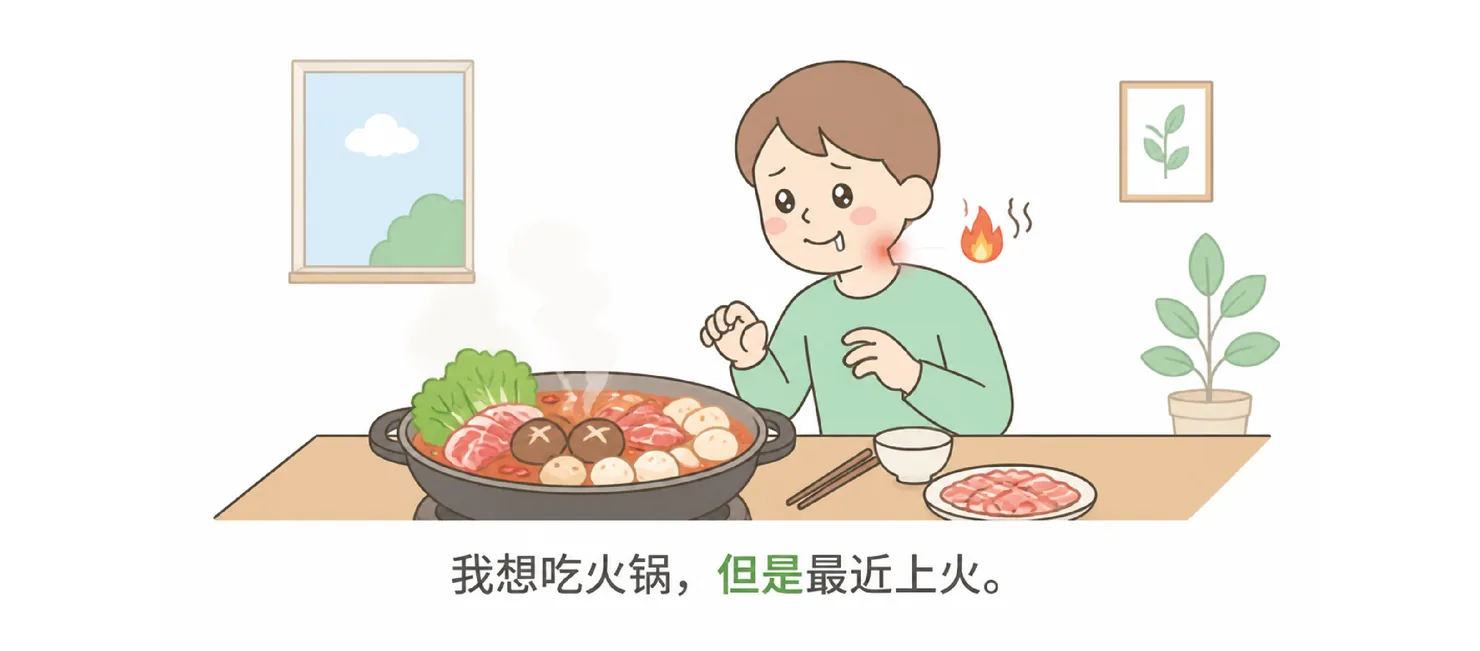 我想吃火锅,但是最近上火。— I want hotpot, but I’ve been having too much internal heat lately.
Similar Words — 可是 and 不过
Mandarin has other ways to say "but" with different emotional tones. 可是 (kěshì) is softer and more empathetic — good for softening a refusal. 不过 (búguò) is casual and mild — it downplays a minor contrast. 但是 stays the neutral default.
可是 is softer/empathetic; 不过 is casual and downplays a minor contrast; 但是 stays the neutral default.
| Word | Pinyin | Meaning | Tone | Best Used When |
|---|---|---|---|---|
| 但是 | dànshì | But / However | Neutral | Default choice — most situations |
| 可是 | kěshì | However | Softer, empathetic | Softening a refusal or expressing empathy |
| 不过 | búguò | But / Though | Casual, mild | Downplaying a minor contrast or reservation |
| Chinese | Pinyin | English | Nuance |
|---|---|---|---|
| 我很想帮你,可是我没时间。 | Wǒ hěn xiǎng bāng nǐ, kěshì wǒ méi shíjiān. | I really want to help you, but I don’t have time. | 可是 shows empathy — softer than 但是. |
| 我很想帮你,但是我没时间。 | Wǒ hěn xiǎng bāng nǐ, dànshì wǒ méi shíjiān. | I want to help you, but I don’t have time. | Neutral. Slightly more direct than 可是. |
| 这个餐厅不错,不过有点贵。 | Zhège cāntīng bùcuò, búguò yǒudiǎn guì. | This restaurant is good, though a bit pricey. | 不过 downplays the negative. |
| 这个电影还行,不过有点长。 | Zhège diànyǐng hái xíng, búguò yǒudiǎn cháng. | This movie is okay, though a bit long. | 不过 keeps the criticism mild. |
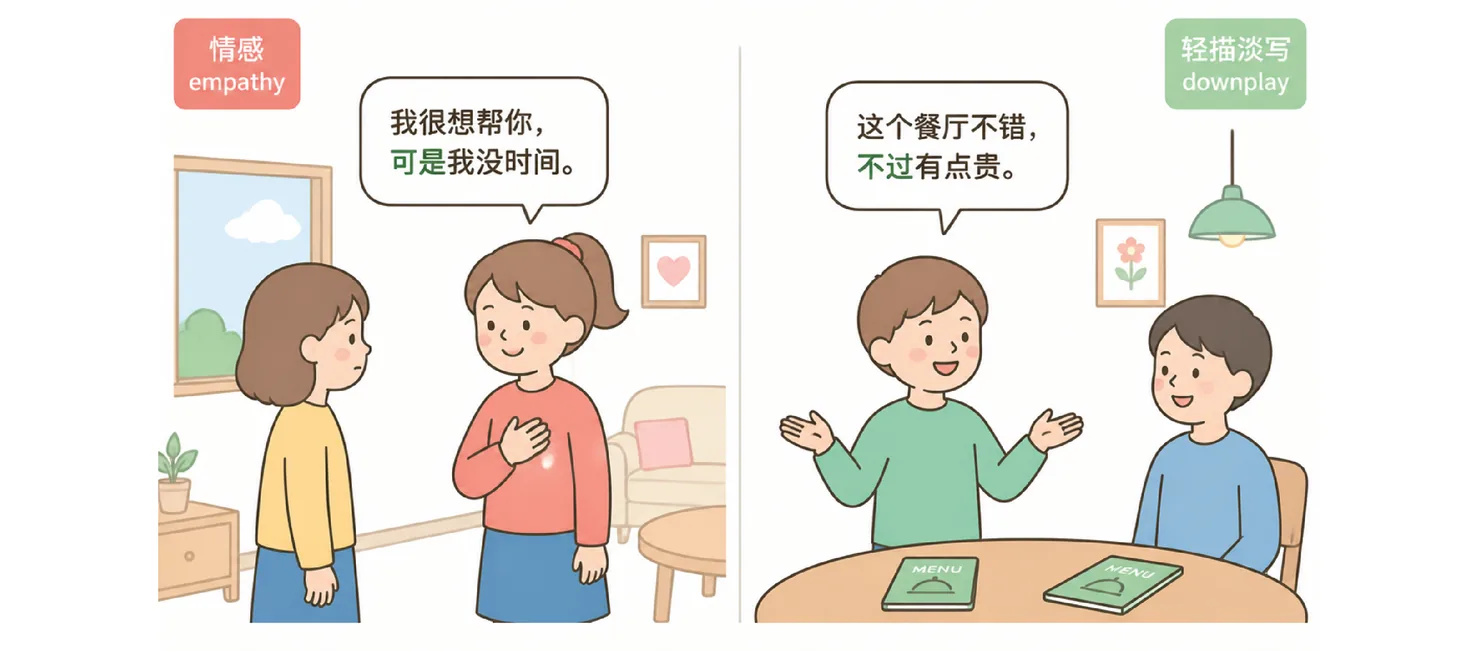 可是 adds an empathetic, softer tone. 不过 downplays the contrast, keeping the criticism mild.
Drills
Fill in each blank with the most appropriate word: 但是, 可是, 不过, or 因为.
- 我想去北京旅行,___ 没有钱。
- 这本书很有趣,___ 有点贵。
- ___ 下雨了,比赛取消了。
- 她学习很努力,___ 考试没通过。
- 我很想帮你,___ 我太忙了。(softer tone, showing empathy)
- 这个餐厅不错,___ 有点贵。(mild, casual contrast)
- 他很有钱,___ 不快乐。
- ___ 天气太冷,他没有出门。
- 这道题很难,___ 我做出来了。
- 我喜欢这个城市,___ 房租太贵了。
- 这个电影还行,___ 有点长。(mild, casual)
- 他很聪明,___ 不太努力。
Answer Key:
- 但是 — contrast (want to go, but no money)
- 但是 — contrast (interesting but expensive)
- 因为 — cause (because it rained)
- 但是 — contrast (studied hard but didn’t pass)
- 可是 — softer, empathetic refusal
- 不过 — mild, casual contrast
- 但是 — contrast (rich but not happy)
- 因为 — cause (because it was cold)
- 但是 — contrast (difficult but I solved it)
- 但是 — contrast (like the city but rent is high)
- 不过 — mild, casual contrast
- 但是 — contrast (smart but not hardworking)
Notes
- In everyday speech, 但是 is your default. 但 alone can sound formal or literary in casual conversation.
- 可是 adds an empathetic or regretful tone — it’s often used when declining something or softening a refusal.
- 不过 is the mildest of the group — use it when the contrast is a minor detail rather than a strong opposition.
- Don’t confuse 但是 with the 虽然…但是 concession pair. 但是 alone introduces simple contrast; 虽然…但是 together expresses “although…but” — a concession, not just a contrast.
Sources
HSK Standard Course 2 — 但是 (L12) HSK Standard Course 3 — 可是, 不过 (L5, L8) Mandarin Grammar References — Conjunctions chapter